Summary:
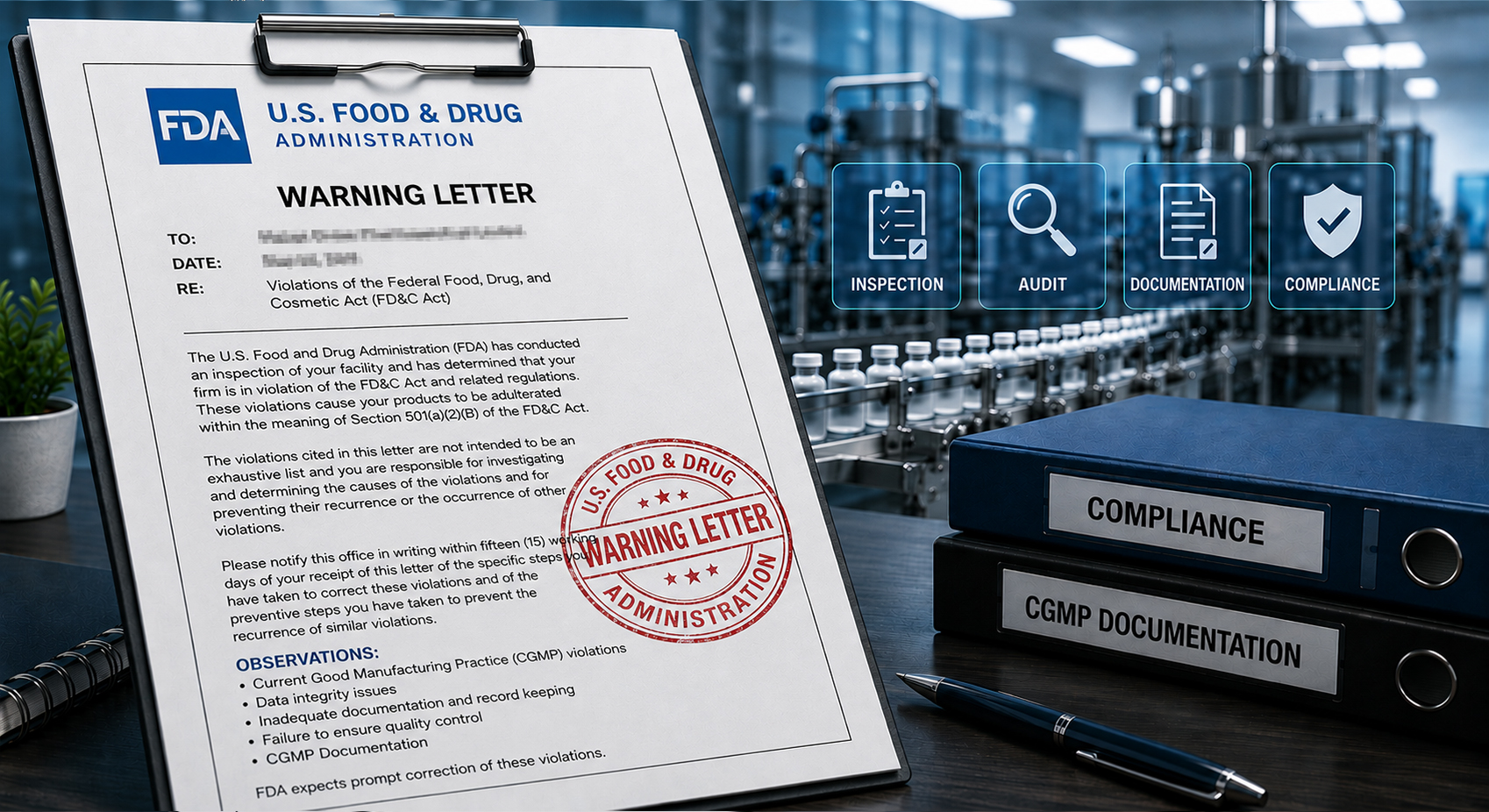
In May 2026, the FDA issued a warning letter to a pharmaceutical manufacturer in Brazil after a routine inspection uncovered four serious CGMP violations and placed every product from that facility on import alert. No single catastrophic event. Just four gaps in quality processes that any manufacturer could have, and most would never catch until it was too late.
What makes this case a wake-up call for the entire industry is how familiar these violations are. Untested batches. Blind trust in supplier paperwork. Manufacturing processes that have never been formally validated. Expiration dates printed on labels with no stability data behind them. These are not exotic failures — they are the everyday gaps that exist when quality management is treated as a documentation exercise rather than a living system.
Here is a breakdown of each violation, its impact on your facility, and how a modern QMS can help prevent it.
Violation 1 — Releasing products without finishing product testing
FDA finding: No identity, strength, or microbial testing before batch release (21 CFR 211.165)
The manufacturer was shipping OTC drug products to consumers without testing active ingredient identity, strength, or microbial contamination. When test results were eventually produced, actives came back below labeled concentration — with no scientific explanation offered. Referenced test methods were described as “modified USP” with no documentation of what was changed or why.
How a QMS prevents this:
Lab management | Batch records | Specification control
A QMS with integrated batch release workflows enforces testing checkpoints before any disposition decision is made. Specifications are stored alongside test methods — including any validated modifications — so every result has a documented standard to compare against. No result, no release. It is that simple, and it is exactly what was missing here.
Violation 2 — Trusting supplier paperwork without verification
FDA finding: No incoming component testing or COA validation (21 CFR 211.84)
Active pharmaceutical ingredients were accepted into production based solely on supplier certificates of analysis. No independent identity, purity, or strength testing was performed. No periodic re-validation of supplier reliability was in place. If a supplier sends you a bad COA, you put bad material into your product — and your patients take it.
How your QMS should address this:
Supplier management | Incoming inspection | Vendor qualification
Supplier qualification is not a one-time event. A QMS should maintain qualification status for every vendor, schedule periodic COA re-validation, and block the use of any material from an unqualified or lapsed supplier. Every incoming batch should have a triggered inspection workflow — with at minimum one specific identity test — before it ever reaches the production floor.
Violation 3 — Manufacturing processes that have never been validated
FDA finding: No process validation or cleaning validation (21 CFR 211.100)
No process validation studies existed to demonstrate that manufacturing was reproducible and in a state of control. Shared equipment cleaning procedures were not validated — meaning the company had no scientific evidence that cleaning between batches was effective. Every batch produced under these conditions carried unknown contamination risk.
How a QMS supports process validation:
Process validation | Equipment management | SOP and document control
Process validation is not a one-off project — it is lifecycle management. A QMS should hold PPQ protocols, track intra-batch and inter-batch variation over time, and flag when a process drifts out of its validated state. Cleaning validation should be linked to equipment records, with worst-case conditions documented and re-validated whenever a new product or piece of equipment is introduced.
Violation 4 — Expiration dates printed without stability data
FDA finding: No stability program to support labeled shelf life (21 CFR 211.137)
Products carried expiration dates that had no stability testing to support them. No ongoing stability program was running. There was simply no way to know whether the product a consumer purchased would remain safe or effective through its stated shelf life — because no one had ever tested it across that timeline.
How a QMS helps maintain product quality:
Stability testing | CAPA management | Quality reporting
An ongoing stability program should be a non-negotiable part of any pharmaceutical QMS. Representative batches added annually. Stability-indicating test methods for each product. Automated reminders at every time point. Trending dashboards that surface early signals before a shelf-life claim becomes indefensible. None of this requires heroic effort — it requires a system that makes it automatic.
The pattern behind all four violations
Every one of these failures shares the same root cause: quality was being managed reactively, in isolation, with no connected system enforcing controls at each step. The fact that the FDA rejected the manufacturer’s corrective action responses tells the same story — commitments made with no supporting documentation, no risk assessments for already-distributed products, no interim plans while fixes were being implemented.
This is not a compliance gap unique to small or overseas manufacturers. It shows up in facilities of every size and geography when quality systems are built on spreadsheets, shared folders, and email chains rather than a purpose-built QMS with enforced workflows, real-time audit trails, and cross-module visibility.
A connected QMS changes the response entirely. When an inspector walks in, every test result, deviation, CAPA, supplier qualification, and stability time point is documented, searchable, and traceable. The answer to every 483 observation already exists — because the system built it in real time, not after the fact.
If any of the four gaps above sound familiar in your facility — whether it is a manual batch release process, a supplier qualification program that lives in a spreadsheet, or stability testing that falls behind schedule — a QMS review is worth doing before your next inspection.
BizPortals QCFlow is built specifically for pharmaceutical and life sciences manufacturers who need CGMP-compliant workflows across the full quality lifecycle, from incoming materials to post-market stability. Book a demo to see how it maps to 21 CFR Parts 210 and 211.