Summary:
Learn what a Nonconformance Report (NCR) is, when it should be raised, what it should include, and how it supports quality control and compliance. This practical guide explains the NCR workflow, dispositions, common mistakes, key metrics, and the role of digital QMS software in managing nonconformances effectively.
A dimensional check on the production line flags a handful of parts that fall outside specification. At first, it looks like an isolated quality issue. A closer review, however, reveals similar parts have already moved to the next operation, another shift has been using a different machine setup, and no one can confidently determine when the variation first appeared. Situations like these remind experienced quality teams that the real risk isn’t the defective parts alone—it’s the lack of visibility into how, when, and why the nonconformance occurred.
In quality management, a nonconformance is any instance where a product, process, service, or system fails to meet a defined requirement. A Nonconformance Report (NCR) turns that observation into a controlled quality record. Instead of relying on conversations, emails, or handwritten notes, it creates a structured quality record, documents immediate actions, maintains traceability, and provides the foundation for investigation, disposition, and, where necessary, corrective action.
Structured nonconformance reporting isn’t just good quality practice. It supports compliance with many quality standards and regulatory requirements across industries. ISO 9001:2015 (Clause 8.7), for example, requires organizations to control nonconforming outputs and take appropriate action to prevent recurrence, making structured nonconformance reporting an important part of maintaining compliance and driving continual improvement.
Beyond supporting compliance, a well-managed NCR process provides reliable quality data that can reveal recurring issues long before they become costly customer complaints or audit findings.
If you’ve ever wondered when an NCR should be raised, what information it should contain, why some nonconformances lead to corrective action while others don’t, or how leading manufacturers manage NCRs across departments, this guide answers those questions with practical, experience-driven guidance.
What is a Nonconformance Report (NCR)?
Whenever a nonconformance is identified, organizations need a consistent way to document, evaluate, and control it. That’s the role of a Nonconformance Report (NCR).
A Nonconformance Report (NCR) is a formal quality record used to document a product, process, service, or system that does not meet a specified requirement. A typical NCR captures key information such as the nature of the nonconformance, the affected product or process, immediate containment actions, and the disposition decision.
The purpose of an NCR is to ensure every nonconformance is handled through a structured, traceable process. Its objective is to support informed decision-making, maintain compliance, reduce the risk of recurrence, and provide reliable evidence for quality improvement and audits.
Why Do Organizations Use Nonconformance Reports (NCRs)?
Most organizations can identify a defective product. The bigger challenge is preserving the information needed to investigate it properly. An NCR creates that record and helps quality teams make consistent decisions based on facts rather than assumptions.
Organizations use nonconformance reports to:
- Standardize the response to quality issues across departments and facilities
- Improve visibility by maintaining a single, traceable record of the nonconformance
- Support timely containment before nonconforming products move further through production or reach customers
- Enable informed decisions on investigation, disposition, supplier action, or corrective action
- Identify recurring trends that reveal process weaknesses and improvement opportunities
- Demonstrate compliance by maintaining documented evidence for audits and regulatory inspections
The best quality teams never treat an NCR as paperwork—they treat it as an opportunity to learn. A defective product tells you what failed; a well-investigated NCR tells you why it failed. That’s where lasting improvements begin.
Are Nonconformance Reports Required by Quality Standards?
If your organization follows a recognized quality management standard, documenting and controlling nonconformances isn’t optional. While many standards don’t specifically require a document called Nonconformance Report (NCR), they do expect organizations to identify nonconforming products or processes, prevent unintended use, investigate quality issues where appropriate, and maintain objective evidence of the actions taken. For most organizations, an NCR is the practical way to meet these expectations.
In practice, these activities don’t happen in isolation. They are typically carried out as part of a broader Quality Management System (QMS), where NCRs work alongside processes such as CAPA, audits, document control, supplier quality management, and training to maintain consistent quality and compliance.
This applies across several industries, including:
- ISO 9001 (Clause 8.7): Control of nonconforming outputs and corrective action
- ISO 13485(Clause 8.3): Control of nonconforming medical devices
- IATF 16949 (Clause 8.7): Management of manufacturing and supplier nonconformities
- AS9100: Control and documentation of nonconforming aerospace products
- FDA Quality Management System Regulation (QMSR): Incorporates ISO 13485:2016 by reference, aligning U.S. medical device quality management requirements with internationally recognized standards
- Good Manufacturing Practices (GMP): Documentation and investigation of quality-related issues
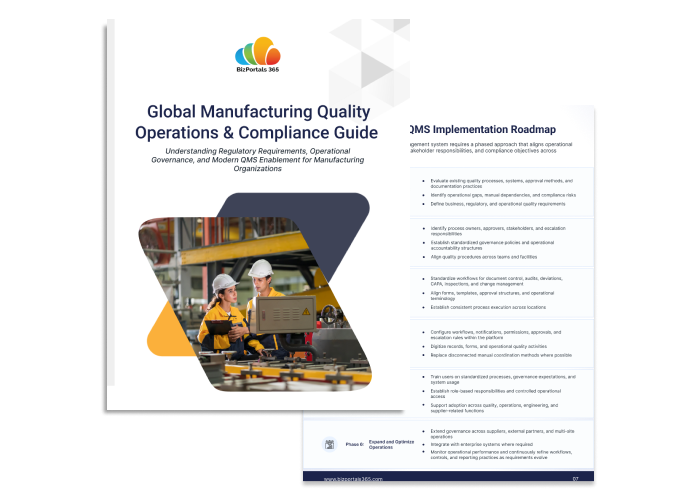
Learn how nonconformance management fits into a broader manufacturing quality strategy, with practical guidance on compliance, connected quality processes, and operational excellence.
Download the GuideWhen should an NCR be Raised?
An NCR should be raised whenever there is objective evidence that a product, process, service, document, or quality system has failed to meet a specified requirement. The decision should not be based on how severe the issue appears at first, but it should be based on whether a defined requirement has been violated.
A simple question often helps quality teams make the right decision:
Can you identify a specific requirement that wasn’t met and support it with objective evidence?
If the answer is yes, there’s a strong possibility that an NCR should be raised.
Some common situations where organizations raise an NCR include:
- Incoming Inspection: A supplier shipment fails dimensional, material, or visual inspection
- Production: An in-process inspection identifies a product that falls outside the specified tolerance or acceptance criteria
- Final Inspection: A finished product fails functional, cosmetic, or performance verification before shipment
- Manufacturing Process: A required inspection, calibration, or production step is skipped or performed outside the approved procedure
- Documentation: A batch record, Device History Record (DHR), production traveler, or controlled document contains missing, incorrect, or unauthorized information
- Food & Pharmaceutical Manufacturing: A critical control point (CCP), sanitation requirement, or GMP procedure is not followed
- Audits: An internal, customer, or certification audit identifies a process that does not conform to documented requirements
- Customer or Supplier Quality: A verified customer complaint, returned product, or supplier quality issue reveals a nonconformance against defined specifications
Ultimately, an NCR should be raised as soon as a verified nonconformance is identified. Early documentation helps contain the issue, preserve objective evidence, and ensure the appropriate actions are taken before the problem spreads further through production or reaches the customer.
What Information Should a Nonconformance Report Contain? Core Components of an NCR Explained
An NCR should capture enough information for someone who was not involved in the incident to understand what happened, assess its impact, and make informed decisions.
While NCR formats vary across organizations, most include the following core components:
| Core Component | Why It Matters |
|---|---|
| Unique NCR ID | Enables traceability, tracking, and audit referencing |
| Date and Location | Establishes when and where the nonconformance was identified |
| Product or Process Details | Identifies the affected item, batch, lot, equipment, or process |
| Description of the Nonconformance | Provides an objective account of what requirement was not met |
| Immediate Containment Actions | Documents how further use, shipment, or processing was prevented |
| Evidence | Supports the findings with inspection results, measurements, photographs, or related records. |
| Disposition Decision | Records how the affected product will be handled (rework, repair, scrap, return, etc.). |
| Responsibilities and Approvals | Identifies who reviewed, approved, and completed the required actions. |
What Are the Steps in an NCR Workflow?
Every nonconformance requires a series of decisions before it can be closed.
Does the affected product need to be contained?
Can it be reworked, repaired, or scrapped?
Does the issue require investigation or corrective action?
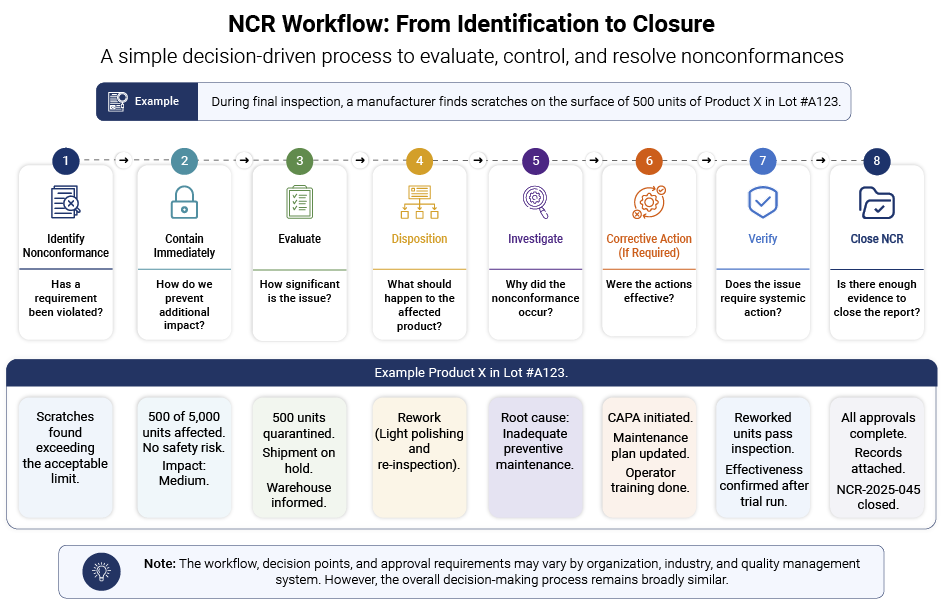
An NCR workflow provides a structured path for answering these questions in the right sequence while ensuring each decision is documented before the next one begins.
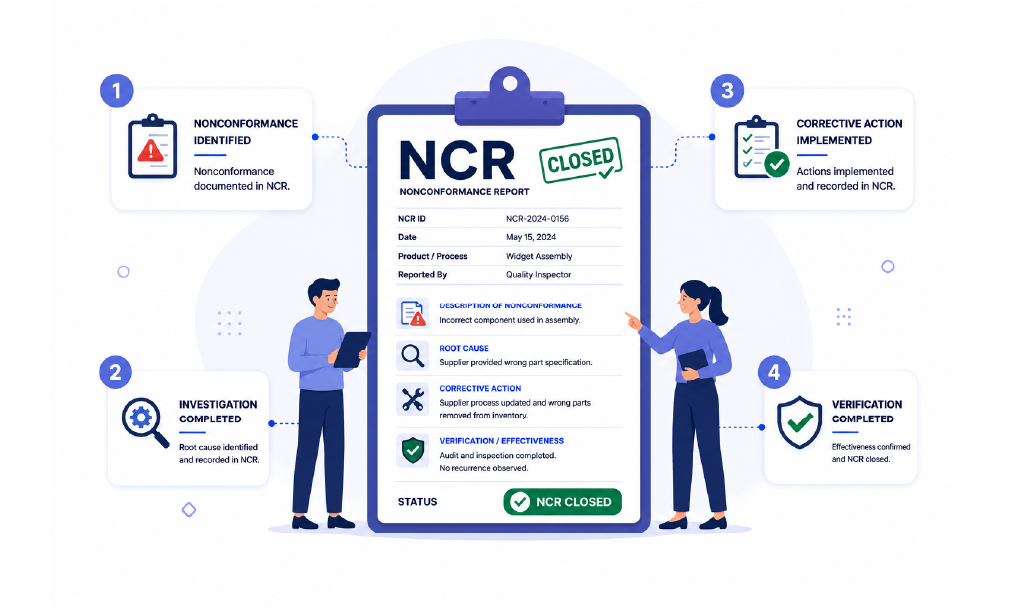
The infographic below shows how a typical NCR progresses from identification to closure, highlighting the key decisions made at each stage of the process. It also follows a practical manufacturing example, illustrating how an NCR moves through each stage from the initial discovery of a nonconformance to final closure.
Understanding NCR Dispositions
Once a nonconformance has been evaluated, the next step is deciding what should happen to the affected product or material. This decision is known as the disposition. It should be based on technical evaluation, product requirements, customer expectations, and applicable regulatory or quality standards and not on production schedules or commercial pressure.
The most common NCR dispositions include:
- Rework: Modify the product so it fully meets the original specification or acceptance criteria
- Repair: Restore the product to a usable condition, even if the method differs from the original design or process. Additional approval may be required
- Scrap: Permanently reject and dispose of the product because it cannot be economically or technically corrected
- Return to Supplier: Send the nonconforming material back to the supplier for replacement, correction, or further evaluation
- Regrade: Reclassify the product for an alternative application where it meets a different set of requirements
- Use As Is: Accept the product despite the nonconformance because the deviation has been evaluated and formally approved without compromising safety, function, quality, or regulatory requirements
- Concession / Deviation Approval: Authorize acceptance of a known nonconformance through documented approval from the appropriate authority, customer, or regulatory body, where permitted
Choosing the wrong disposition can create greater risk than the original nonconformance. Every decision should be supported by objective evidence, documented approvals, and a clear understanding of the potential impact on quality, compliance, and the customer.
The best disposition is not always the least expensive or the fastest. It is the one you can confidently justify months later during an audit, customer review, or internal investigation using objective evidence and documented facts.
Some NCRs require more than disposition. Learn how effective CAPAs eliminate root causes and help prevent recurring quality issues.
Download the GuideHow to write an Effective NCR: Step-by-Step
Writing an NCR isn’t about filling out a form. It’s about capturing the facts in a way that leaves no room for guesswork. When the information is accurate, complete, and objective, quality teams can evaluate the issue, make informed decisions, and move the process forward with confidence.
Step 1: Describe the Nonconformance Objectively
Record only what was observed and avoid assumptions, opinions, or conclusions.
Clearly state the requirement that wasn’t met and support the description with objective evidence such as measurements, inspection results, photographs, test reports, or document references.
Good example: During final inspection, three of the twenty sampled parts measured 25.35 mm against the specified tolerance of 25.00 ± 0.20 mm.
Step 2: Record the Immediate Containment Actions
Document the actions taken to prevent the issue from affecting downstream operations or reaching the customer. This may include quarantining affected material, stopping production, segregating inventory, or notifying relevant departments.
Step 3: Assess the Scope and Impact
Determine whether the issue is isolated or whether additional products, batches, production lots, suppliers, or customers may also be affected. Defining the scope early helps prevent incomplete investigations and repeated NCRs.
Step 4: Select the Appropriate Disposition
Based on the technical evaluation, decide how the nonconforming product will be handled, whether through rework, repair, return to the supplier, scrap, regarding, or use-as-is with the required approvals. Every disposition should be supported by documented justification.
Step 5: Investigate the Cause (When Required)
Not every NCR requires a full root cause investigation. However, when the issue is recurring, significant, or presents a quality or compliance risk, investigate why it occurred using an appropriate problem-solving method and determine whether corrective action is necessary.
Step 6: Verify Before Closing the NCR
Before closing the record, confirm that all required actions have been completed, approvals have been obtained, and the nonconformance has been satisfactorily resolved. If corrective actions were implemented, verify their effectiveness to reduce the likelihood of recurrence.
Nonconformance Report Example
Common NCR Mistakes that Trigger Audit Findings
Many NCRs fail for reasons that have nothing to do with the nonconformance itself. They fail because important information is missing, decisions are made too early, or the record doesn’t clearly explain what happened. These are some of the most common issues auditors and quality managers encounter during NCR reviews.
- Jumping directly to CAPA: Not every nonconformance requires corrective action. Assess the significance of the issue before initiating a CAPA.
- Writing vague descriptions: Statements like Part failed inspection”provide little value. Clearly describe what happened, which requirement was not met, and support it with objective evidence.
- Recording assumptions instead of facts: Conclusions should never replace evidence. Document observations first, then investigate the cause if required.
- Weak or delayed containment: Failing to isolate affected products promptly can allow the issue to spread through production or reach the customer.
- Ignoring the scope of the issue: Limiting the investigation to a single defective product may overlook similar nonconformances in other batches, lots, or processes.
- Closing the NCR too early: An NCR should only be closed after all required actions, approvals, and verification activities have been completed.
How Do You Know If Your NCR Process Is Working?
Raising and closing NCRs is only part of the process. The real value comes from analyzing NCR data over time to identify recurring issues, evaluate the effectiveness of corrective actions, and uncover opportunities for continual improvement. Without meaningful measurement, organizations often end up solving individual nonconformances without addressing the underlying patterns behind them.
Rather than relying on a single KPI, effective quality teams monitor a combination of NCR metrics to understand process performance, supplier quality, response times, recurring issues, and the overall health of their quality management system.
If you’d like a deeper look at the metrics discussed above, our guide, The Nonconformance Metrics Every Quality Manager Should Track, explores the KPIs quality teams commonly use to evaluate NCR performance, identify trends, and improve their quality management system.
Managing NCRs in a Digital QMS
As organizations grow, managing NCRs through spreadsheets, paper forms, or email-based approvals becomes increasingly difficult. Information gets scattered across departments, investigations take longer to coordinate, follow-up actions are missed, and identifying recurring trends often requires significant manual effort. These challenges don’t usually stem from the NCR process itself, they stem from the tools used to manage it.
A QMS software brings every stage of the NCR lifecycle into a single, connected workflow. Instead of searching through multiple files or chasing updates across teams, quality professionals can document nonconformances, assign responsibilities, monitor progress, and maintain complete traceability from identification to closure.
Key capabilities typically include:
- Centralized NCR records that provide a single source of truth for every quality event
- Configurable workflows that automate reviews, approvals, escalations, and notifications
- Real-time dashboards and trend analysis that help identify recurring nonconformances and emerging quality risks
- Integrated quality processes that seamlessly connect NCRs with CAPA, supplier quality, audits, training, document control, and other quality records
- Complete audit trails that capture every action, approval, and status change, making audit preparation significantly more efficient
The real advantage of a QMS software isn’t that it replaces paper forms. It transforms isolated NCRs into connected quality intelligence. A dedicated Nonconformance Management module forms the foundation of this approach by linking NCRs with CAPA, audits, supplier quality, document control, and other quality processes, enabling organizations to respond faster, uncover recurring issues sooner, and make better decisions.
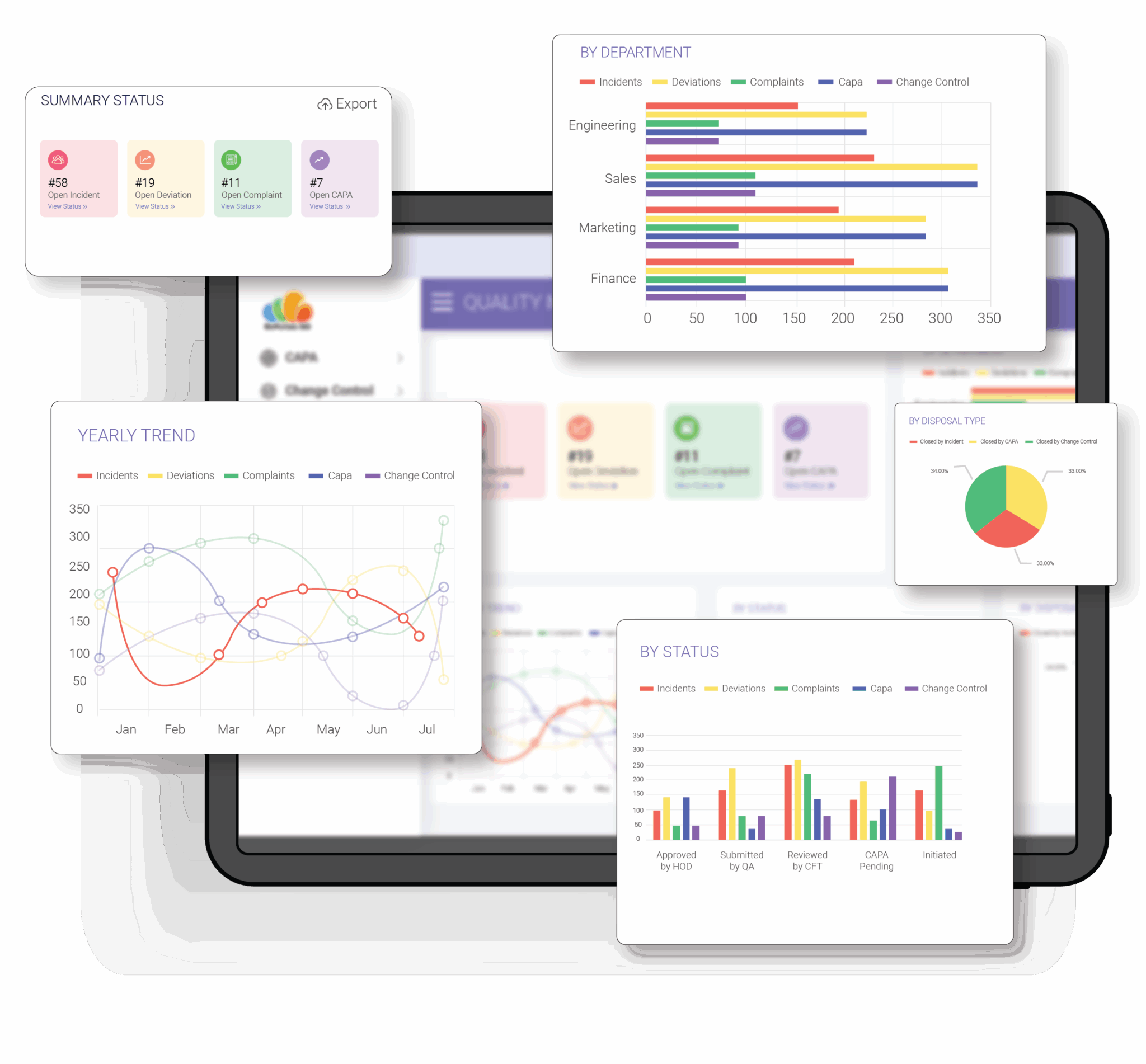
Digitize every step with BizPortals QCFlow's Nonconformance Management module.
Request a DemoFAQs
-
What is the difference between a nonconformance and a nonconformance report?
A nonconformance is the quality issue itself. A nonconformance report is the document used to record, investigate, and track that issue until resolution.
-
Who is responsible for raising and closing a nonconformance report?
Anyone who identifies a nonconformance may raise an NCR. It is typically reviewed and closed by authorized quality personnel after required actions are completed.
-
Does every nonconformance require a CAPA?
No. Not every NCR results in a CAPA. CAPA is used when investigation identifies a root cause that requires corrective action to prevent the issue from happening again.
-
What happens if a nonconformance is left unresolved?
Unresolved nonconformances can lead to recurring defects, compliance issues, customer complaints, audit findings, and increased operational risk.
-
How long should a nonconformance report remain open?
An NCR should remain open until all required actions, reviews, and verification activities are completed. There is no standard timeframe.
-
Can a nonconformance report include multiple nonconformances?
Generally, each NCR should document one nonconformance to ensure accurate investigation, clear traceability, and effective corrective action.
-
What is the difference between an NCR and a Corrective Action Request (CAR)?
An NCR records a nonconformance. A Corrective Action Request (CAR) initiates actions to eliminate the root cause and prevent recurrence when required.
-
Can a supplier nonconformance be documented using a nonconformance reporting process?
Yes. Organizations often use NCRs to document supplier-related quality issues before deciding whether additional supplier corrective actions are required.