Summary:
This guide explores quality, quality management, and QMS, detailing principles, core processes, metrics, digital solutions, and implementation best practices. Designed for quality leaders, operational heads, and industry decision-makers, it helps them strengthen process control, ensure compliance, embed continuous improvement, and make data-driven quality decisions for consistent, scalable organizational performance.
Quality simply means meeting defined requirements and customer expectations consistently. It is applicable to products, services, processes, and decisions. Following a structured approach to ensure quality by systematic planning, implementation, and monitoring is called quality management, and the system that formalizes this approach is called a quality management system.
Quality is one of those words everyone uses, but few stop to define clearly.
We hear it in meetings, see it in reports, and assume we all mean the same thing. Most of the time, we do not. It only becomes obvious when something goes wrong.
What do contaminated medicines, mid-flight aircraft emergencies, and improvements in citizen services have in common?
They all come down to the same issue: whether quality is supported by a system or left to chance.
In everyday business terms, quality is about things working the way they are supposed to, customers getting what they expect, and teams not constantly fixing the same problems again and again. Quality shows up in products, services, internal processes, decisions, and even in how quickly issues are handled.
So why does quality still break in modern organizations, even with experienced teams and advanced technology? This is where the focus shifts from quality itself to how it is actually managed.
A good place to start is understanding how quality is managed in practice.
What Is Quality Management (QM) and Why It Is a Leadership Discipline
Definition: Quality management is the structured way an organization defines how work should be done, monitors whether it is done correctly, and improves those methods to maintain consistent and reliable results. It is a systematic approach that brings together planning, execution, evaluation, and improvement so that quality becomes part of the way an organization works — and not something that is tested at the end of a process.
Quality management helps an organization:
- Be clear about what needs to be done and what success looks like
- Keep work running in a steady, predictable way
- Cut down mistakes, repeat issues, and firefighting
- Make sure teams work the same way, even across locations
- Use past problems to improve how work is done
Quality management did not begin as a leadership idea. In the early 1900s, as mass production took hold in factories across the United States and Europe during the Industrial Revolution, quality was handled mainly through end-of-line inspection. Products were checked after they were made, and defects were simply sorted out.
By the 1930s and 1940s, especially in large manufacturing operations, this approach proved expensive and wasteful. Early thinkers like Walter Shewhart introduced ideas such as control charts, showing that monitoring how work behaves during the process mattered more than inspecting results after the fact.
Problems kept repeating because the way work was planned never changed. Over time, attention shifted from checking results to shaping how work was designed and managed. That shift is why quality management became a leadership responsibility, not just an operational one.
Once quality became a leadership responsibility, it could no longer rely on informal practices or individual judgment. Leaders needed a clear and repeatable way to guide how work was done across teams, locations, and time. This need for consistency is what led organizations to manage quality through a system.
What Is a Quality Management System – A Practical Definition
Definition: A quality management system is the framework an organization uses to make sure quality is not left to individual effort or good intentions. It brings expectations, ways of working, checks, and improvements into one connected setup that people can actually follow.
In simple terms, a quality management system answers a few basic questions:
- How work should be done
- How leaders know it is being done well
- What happens when it is not
This matters because informal ways of working stop holding up as organizations grow. What works in small teams often breaks down when scale enters the picture. Informal practices start to fail when:
- Work depends too much on specific people rather than shared methods
- Decisions are made differently across teams and locations
- Problems get fixed temporarily but keep coming back
- Leaders lack clear visibility into what is really happening
- Growth outpaces the organization’s ability to stay consistent
A quality management system exists to address these gaps. It gives leaders a way to turn intent into action and experience into standard practice. Instead of relying on memory or habit, it creates clarity around how workflows are structured, how performance is checked, and how improvement happens over time.
This is what allows quality to remain stable even as the organization changes. And it is why quality management systems become essential once complexity, scale, and risk increase.
Quality Management Principles That Drive Performance
Quality management principles define the foundational rules that guide how an organization plans, executes, and improves its processes to achieve consistent results. In practice, these principles are applied through structured activities such as quality assurance and quality control, which ensure that procedures, standards, and operational controls are consistently followed across the organization.
Quality management principles ensure that quality is built into operations through leadership direction, structured execution, and continuous evaluation. A quality management system becomes effective when these principles shape daily decisions and management practices. They provide a stable framework that aligns teams, improves reliability, and supports long-term operational performance.
These quality management principles are widely formalized in frameworks developed by the International Organization for Standardization, particularly in ISO 9001, which defines how organizations establish and maintain effective quality systems.
1. Customer-Centric Quality
Customer focus ensures that processes, products, and services consistently meet defined requirements and expectations. It shifts attention from internal assumptions to externally validated outcomes.
Organizations that maintain customer focus define clear requirements, monitor feedback, and adjust processes when expectations change. This improves reliability and strengthens long-term trust.
Why this matters: Customer focus ensures that quality efforts remain relevant and directly tied to measurable outcomes and stakeholder expectations.
2. Leadership and Accountability
Leadership ensures that quality priorities are clearly defined and supported across the organization. It establishes objectives, assigns responsibility, and ensures that quality remains part of operational decision-making.
When leadership maintains active involvement, quality becomes part of how work is managed rather than a separate compliance activity.
Why this matters: Leadership ensures consistency by aligning quality objectives, accountability, and operational execution across the organization.
3. Process-Driven Approach
The process approach ensures that work is defined, controlled, and managed as interconnected activities rather than isolated tasks. This improves consistency and makes outcomes more predictable. Clearly defined processes also make it easier to monitor performance, identify deviations, and implement improvements.
Why this matters: Managing work as defined processes improves visibility, control, and the ability to maintain consistent results.
4. Evidence-Based Decision Making
Evidence-based decision making ensures that quality decisions rely on data, observations, and verified information. This prevents decisions based on assumptions or incomplete understanding. Performance metrics, audit findings, and incident data provide objective insight into how processes are functioning and where corrective action may be needed.
Why this matters: Evidence-based decisions reduce uncertainty and enable faster, more accurate corrective and preventive actions.
5. Continuous Process Improvement
Improvement ensures that processes are regularly evaluated and refined based on performance results and operational experience. It allows organizations to address weaknesses, adapt to change, and strengthen long-term performance.
Continuous improvement prevents stagnation and ensures that the quality management system remains relevant and effective over time. For example, structured practices such as CAPA quality improvement allow organizations to investigate root causes of recurring issues and implement changes that strengthen process reliability.
Why this matters: Continuous evaluation ensures that the organization can adapt to operational changes without losing stability or control.
How Quality Management Principles Support an Effective QMS
Quality management principles provide the foundation that guides how the quality management system is designed and operated. They ensure that processes remain aligned with organizational goals, operational realities, and customer expectations. By applying these principles consistently, organizations improve process control, strengthen accountability, and maintain stable performance even as operations evolve.
Core Components of an Effective Quality Management System
The core components of a quality management system are the structural elements that define how quality is directed, controlled, monitored, and continuously improved across the organization.
The key components of a quality management system include quality objectives, process ownership, governance of documents, risk handling, performance visibility, and process improvement framework. Each component plays a distinct role while remaining closely interconnected with others, ultimately forming a robust structure that governs how quality is achieved and sustained.
1. Quality Direction and Objectives
Leaders or responsible stakeholders must clearly define what quality means for the organization and what matters most in terms of results. These objectives set priorities, guide choices, and provide a reference point for decisions. Without clear objectives, quality actions become inconsistent and reactive.
2. Process Definition and Ownership
A QMS must define how critical work is performed and who is responsible for it. Clearly defined processes reduce variation, while ownership ensures accountability for results. When either is unclear or absent, quality depends more on individual experience than on systematic control.
3. Governance of Documents and Records
Well-defined document governance rules help ensure that people use the correct procedures, forms, and records at the right time. Controlled documents prevent outdated instructions from driving errors, while reliable records provide evidence of what was actually done and support investigation when issues occur.
4. Risk and Nonconformance Handling Model
Effective risk and nonconformance management define how potential failures are identified and how actual deviations are handled. In quality systems, these deviations are typically classified as nonconformances, which must be formally documented, investigated, and resolved to prevent recurrence. This structured approach allows the organization to act early, minimize impact, and avoid repeated issues — leading to less rework and scrap.
5. Problem Resolution and Prevention Approach
An effective quality management system addresses problems at their source. This approach defines how issues are investigated, corrected, and prevented from recurring. The focus remains on addressing root causes rather than symptoms. Strong problem resolution reduces repeat issues and stabilizes quality operations.
6. Performance Visibility and Oversight
Ongoing performance monitoring offers visibility into whether processes are delivering expected results. Data from monitoring activities, including dashboards and reports, supports informed decisions and timely intervention. Regular review keeps quality at the core of routine management, not a periodic exercise.
7. Learning and Improvement Framework
Lessons from audits, incidents, and performance trends are used to adjust how work is designed and managed. Over time, this continuous learning keeps processes relevant as conditions change and expectations rise.
Core QMS Processes and How Quality Is Managed Day-to-Day
Core QMS processes are the operational workflows that control how quality is maintained, verified, and improved during routine work. These processes ensure that quality is managed through defined actions, clear ownership, and structured review.
A quality management system operates through governance processes that control documentation, issue handling, corrective actions, changes, audits, and training. These processes provide structure for execution and ensure that quality-related decisions are traceable and verifiable.
These governance processes translate quality expectations into daily execution. They allow organizations to manage deviations formally, implement corrections reliably, and maintain control as operations grow in scale and complexity.
1. Document Control
Document control defines how procedures, policies, and work instructions are created, reviewed, approved, and updated as a part of a structured document control process. It ensures that teams use the correct and current instructions. Without document control, outdated or incorrect procedures may remain in use. Controlled documentation establishes a reliable reference and maintains records that support traceability and investigation.
2. Audit Management
Audit management is how structured reviews evaluate whether processes are followed and remain effective through internal quality audits and standardized review procedures. It provides visibility into steps taken, process gaps, and areas requiring corrective action. Audits also ensure whether the quality management system continues to function as intended over time.
3. Incident and Deviation Management
Incident and deviation management defines how errors, failures, or unexpected quality events are reported and assessed, often supported by structured tools such as incident management software. It makes sure that problems are formally documented and accessible to responsible teams. This structured reporting helps organizations detect recurring issues and take appropriate corrective action. In many quality environments, these deviations are formally tracked using nonconformance management software to ensure proper investigation and resolution.
4. CAPA Management
Corrective and preventive action refers to how root causes are investigated and resolved through a structured CAPA process. Corrective actions address existing causes, while preventive actions reduce the likelihood of future occurrences. This process strengthens process control by ensuring that issues lead to permanent resolution.
In practice, organizations often document corrective actions using structured formats such as a CAPA action plan or standardized CAPA reports to ensure issues are investigated, documented, and resolved systematically.
5. Change Management
Change management defines how process updates, system modifications, or operational adjustments are evaluated before implementation. It ensures that changes are assessed, approved, and introduced in a controlled manner, preventing unintended consequences and maintaining continuity in process execution.
6. Training Management
Training management refers to how employees are trained and qualified to perform assigned tasks. It ensures that procedures are understood and applied correctly. Training records also provide evidence of qualification, which supports accountability and operational confidence.
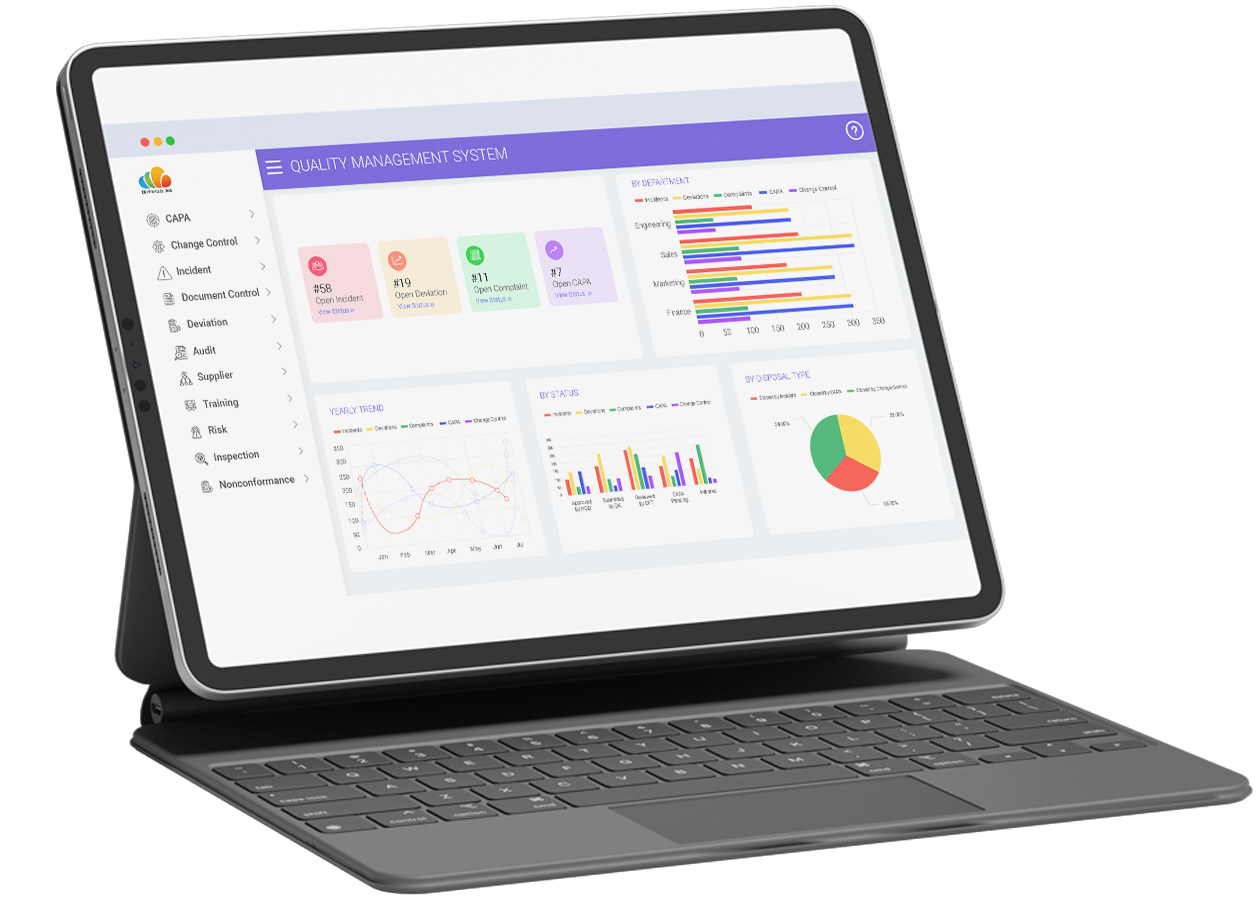
Explore how audits, CAPA, incidents, and documents are managed through structured workflows.
Book a DemoHow Core QMS Governance Processes Function Together in Daily Operations
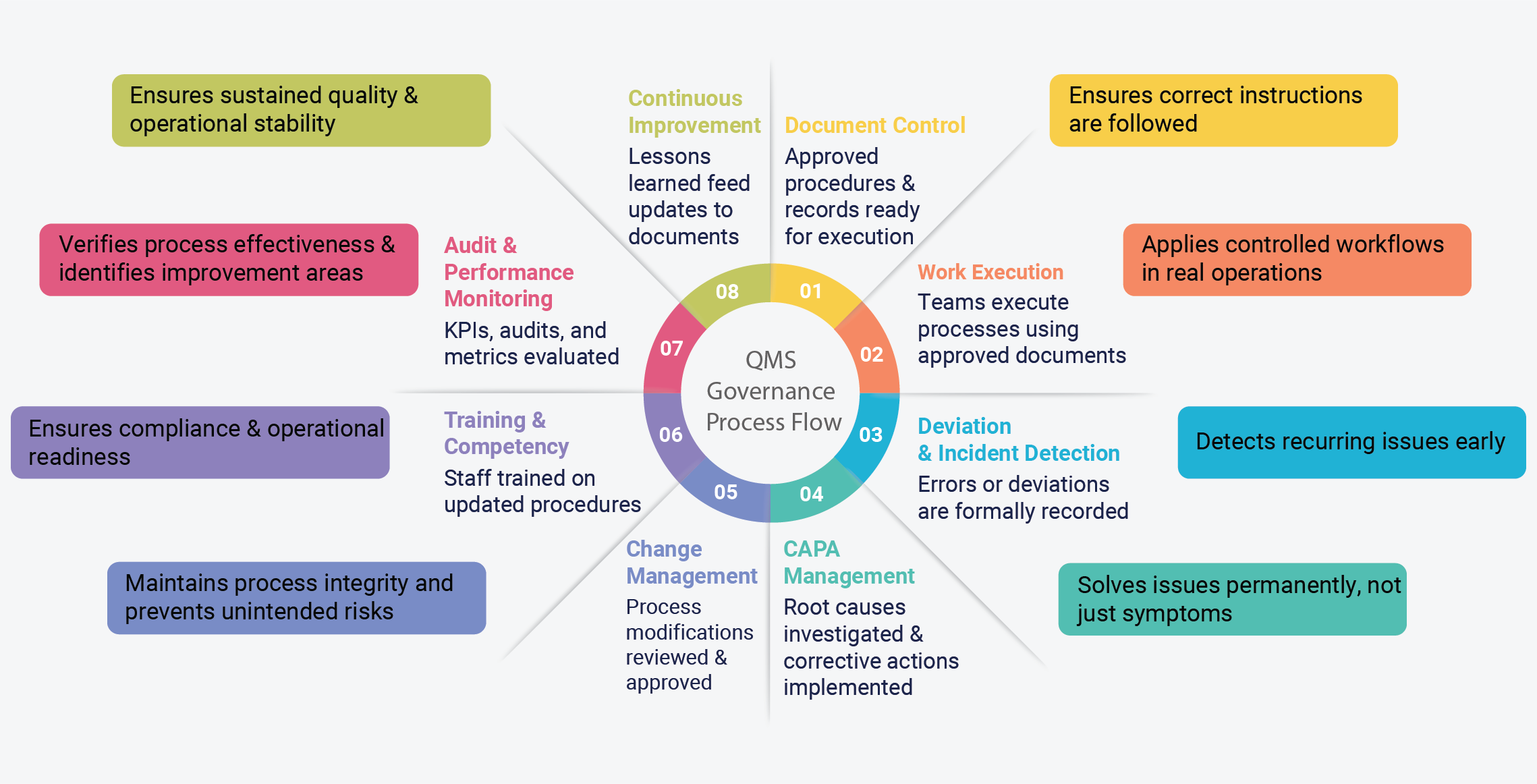
Core QMS governance processes work together to manage how quality issues are identified, corrected, and prevented through a structured and traceable approach. Each governance process supports a specific stage in maintaining process control.
When a deviation occurs, incident or deviation management ensures the issue is formally recorded. CAPA management investigates the cause and defines corrective actions. If updates are required, change management ensures modifications are reviewed and approved before implementation.
Document control ensures updated procedures become the approved reference, and training management ensures employees follow the revised methods. Audit management and performance monitoring verify whether corrective actions and process updates are effective.
This operational cycle allows the quality management system to govern daily work, resolve issues systematically, and maintain controlled execution over time.
Why Modern Organizations Are Moving to Digital QMS
A digital QMS (Quality Management System) is a software-based platform that manages quality processes through structured workflows, centralized records, and real-time visibility. It replaces manual tracking with controlled, traceable, and automated process management.
As organizations grow in scale, complexity, and regulatory exposure, manual quality systems become difficult to sustain. Digital QMS platforms provide the control, transparency, and reliability required to manage quality consistently.
A) The Problem with Manual Quality Systems
Manual QMS environments rely on spreadsheets, shared folders, emails, and static documents. Tools such as spreadsheets can record data, but they cannot enforce workflows, track accountability, or ensure approvals are completed.
Key Limitations:
- No workflow enforcement
- Limited real-time visibility
- High dependency on manual follow-up
- Increased risk of missed approvals
- Outdated procedures remaining in use
- Time-consuming audits and investigations
As document volume and corrective actions increase, manual coordination becomes unreliable.
B) How Digital QMS Solves These Challenges
Digital QMS platforms introduce structure, automation, and system-level control.
1. Structured Workflows
- Automated task routing
- Defined approval steps
- Built-in escalation
- Complete audit trails
Result: Consistent execution and clear accountability.
2. Centralized and Controlled Records
- Single source of truth
- Version control
- Controlled access
- Full history tracking
Result: Improved accuracy, traceability, and audit readiness.
3. Real-Time Visibility
- Live dashboards
- Open issue tracking
- Performance monitoring
- Trend analysis
Result: Faster response and proactive risk management.
4. Integration with Operational Systems
Digital QMS platforms integrate with ERP, MES, and CRM. For example, integration with enterprise platforms like Acumatica ensures quality events align directly with operational workflows.
Result: Reduced data duplication, improved data accuracy, and stronger cross-functional coordination.
C) What This Means for Modern Organizations
Digital QMS transforms quality management from manual coordination into a structured, data-driven system. It enables organizations to:
- Maintain consistent process execution
- Strengthen compliance and audit readiness
- Reduce operational risk
- Improve accountability
- Scale quality management with business growth
Metrics That Actually Matter in Quality Management
Quality management metrics are measurable indicators that show whether processes are performing as expected and whether improvement actions are effective. These metrics provide objective evidence of process stability, issue resolution, and overall system effectiveness.
A quality management system relies on meaningful metrics to detect risks early, evaluate corrective actions, and support informed decision-making. Without reliable metrics, quality performance cannot be accurately understood or managed. Effective quality metrics focus on process outcomes, corrective action effectiveness, and long-term stability rather than isolated activity counts.
1. First Pass Yield (FPY)
Measures the percentage of work completed correctly without rework. It reflects process accuracy and execution consistency.
Formula: (Number of units completed without rework ÷ Total units processed) × 100
2. Defect Rate
Measures how often defects occur in a process or product. It indicates overall process quality.
Formula: (Number of defects identified ÷ Total units produced) × 100
3. CAPA Closure Rate
Measures how many corrective and preventive actions are completed within a defined period. It reflects responsiveness and action completion.
Formula: (Number of CAPAs closed ÷ Total CAPAs opened) × 100
4. CAPA Effectiveness Rate
Measures how many corrective actions successfully prevent recurrence of the issue. It reflects root cause resolution strength.
Formula: (Number of effective CAPAs ÷ Total CAPAs implemented) × 100
5. Deviation Rate
Measures how frequently deviations occur relative to total operations. It indicates process control strength.
Formula: (Number of deviations reported ÷ Total process activities) × 100
6. Audit Finding Rate
Measures the number of audit findings relative to audits conducted. It reflects compliance and process discipline.
Formula: Number of audit findings ÷ Total audits conducted
7. Repeat Finding Rate
Measures how often previously identified issues reappear. It indicates whether corrective actions were effective.
Formula: (Number of repeated findings ÷ Total findings) × 100
8. Change Success Rate
Measures how many implemented changes do not result in incidents or deviations. It reflects effectiveness of change control.
Formula: (Number of successful changes ÷ Total changes implemented) × 100
9. Training Completion Rate
Measures the percentage of required training completed by employees. It reflects workforce readiness.
Formula: (Number of completed training assignments ÷ Total required training assignments) × 100
10. Document Compliance Rate
Measures how many documents are current and approved. It reflects document control effectiveness.
Formula: (Number of approved current documents ÷ Total active documents) × 100
11. Incident Resolution Time
Measures the average time required to investigate and close quality incidents. It reflects response efficiency and the maturity of the organization’s incident management process.
Formula: Total time to close incidents ÷ Number of incidents closed
12. Customer Complaint Rate
Measures how often customers report quality issues. It reflects external quality performance.
Formula: (Number of customer complaints ÷ Total units delivered) × 100
13. On-Time CAPA Completion Rate
Measures the percentage of CAPAs completed within the defined deadline. It reflects process discipline.
Formula: (Number of CAPAs closed on time ÷ Total CAPAs closed) × 100
14. Audit Closure Rate
Measures how quickly audit findings are resolved. It reflects follow-up effectiveness.
Formula: (Number of audit findings closed ÷ Total audit findings) × 100
15. Cost of Poor Quality (COPQ)
Measures the financial impact of defects, rework, and quality failures. It reflects overall quality performance impact.
Formula: Total cost of rework + scrap + returns + corrective actions
Common QMS Implementation Mistakes and How to Avoid Them
Common QMS implementation mistakes are structural and operational gaps that prevent the quality management system from functioning as intended. These gaps reduce process control, weaken accountability, and limit the system’s ability to support consistent and reliable execution.
A quality management system must be designed for real operational use, not just documentation or certification. The following checklist highlights the most critical mistakes organizations must avoid to ensure that the system remains effective and sustainable.
QMS Implementation Checklist: Mistakes to Avoid
- Defining documentation without defining actual workflows — Procedures must reflect how work is performed, not how it is assumed to work.
- Creating excessive documentation that adds complexity — Too many documents make the system difficult to use, maintain, and enforce.
- Implementing QMS primarily for certification or audit purposes — Systems designed only for audits often fail to support daily operational control.
- Assigning unclear ownership for processes and quality responsibilities — Each process must have defined ownership to ensure accountability and follow-through.
- Implementing software before establishing process structure — Tools can support workflows, but they cannot replace clearly defined processes.
- Lack of leadership oversight and involvement — Leadership involvement ensures that quality management remains a visible and enforced priority.
- Failure to train employees on procedures and system usage — Without training, procedures may exist formally but not be followed in practice.
- Allowing outdated procedures and documents to remain active — Uncontrolled or outdated documents can lead to inconsistent execution.
- Treating corrective actions as formalities instead of root cause resolution — Corrective actions must eliminate underlying causes, not just address immediate symptoms.
- Failure to monitor system performance and effectiveness — Without monitoring, weaknesses in process control may remain undetected.
- Ignoring feedback from audits, incidents, and operational experience — Feedback provides essential input for strengthening process reliability.
- Failure to update the QMS as processes and operations evolve — The system must remain aligned with current operational structure and risk profile.
A quality management system becomes effective when it is practical, actively used, and regularly maintained. Avoiding these implementation mistakes ensures that the system supports process control, strengthens accountability, and remains relevant as the organization grows and changes.
Once implemented correctly, the quality management system must be continuously monitored to verify performance, maintain control, and ensure long-term operational reliability.
Why Continuous Monitoring Is Essential for Sustained Quality Control
Continuous monitoring ensures that quality is maintained consistently as systems, processes, and operational conditions evolve. It enables organizations to continuously verify performance, stability, and operational integrity against defined quality standards.
Without continuous monitoring, quality degradation may remain unnoticed until failures occur. A structured quality management solution enables teams to maintain oversight, validate operational reliability, and ensure that quality standards remain consistently enforced.
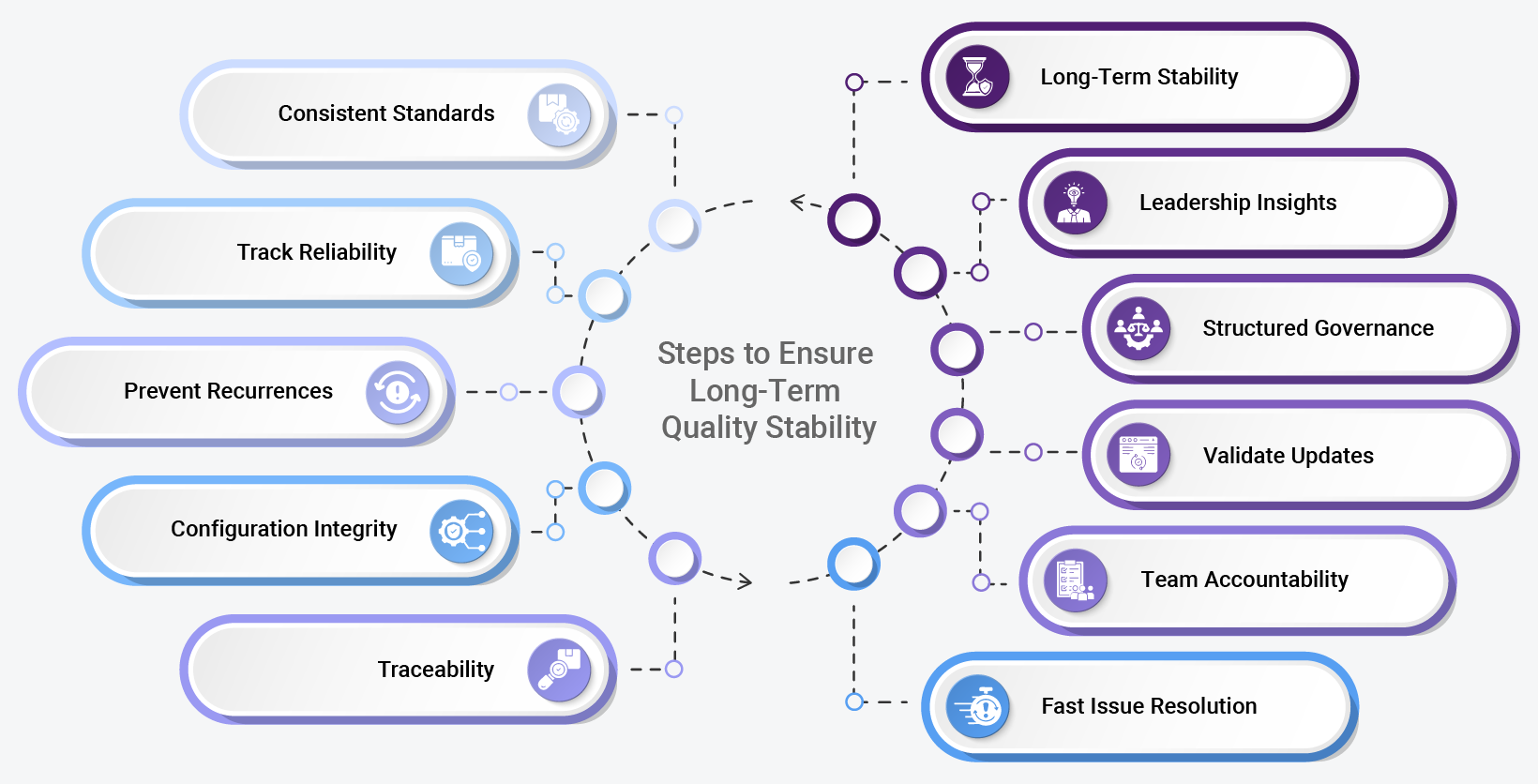
Continuous Monitoring for Sustained Quality Control
- Maintain consistent operational standards — Ensure processes continue to meet defined quality benchmarks.
- Track system reliability over time — Monitor stability, uptime, and operational consistency.
- Prevent recurring quality issues — Identify patterns and address root causes permanently.
- Ensure configuration and process integrity — Detect unintended changes affecting quality.
- Maintain full traceability of quality events — Record issues, actions, and resolutions systematically.
- Support faster issue resolution — Enable teams to investigate and resolve issues efficiently.
- Improve accountability across teams — Ensure clear ownership of quality outcomes.
- Validate quality after updates and operational changes — Confirm that modifications do not introduce new risks.
- Support structured quality governance — Ensure quality performance can be reviewed and validated when required.
- Provide leadership with measurable quality insights — Support informed operational and strategic decisions.
- Enable long-term quality stability — Ensure quality performance remains consistent as systems scale.
Summary and Final Perspective
Quality management becomes effective when it moves beyond documentation and becomes embedded in how work is directed, executed, monitored, and improved. Organizations that define clear expectations, assign ownership, manage risks proactively, and rely on objective performance indicators gain control over outcomes rather than reacting to failures.
A disciplined quality management system creates operational clarity, strengthens accountability, and builds resilience into everyday processes. As organizations grow and complexity increases, sustained performance depends not only on implementation, but on maintaining oversight, adaptability, and continuous evaluation over time.
For organizations seeking a scalable enterprise QMS platform, BizPortals QCFlow supports controlled quality workflows, operational traceability, centralized governance, and integrated compliance management across enterprise quality operations. Explore how BizPortals QCFlow helps organizations standardize quality operations, strengthen compliance governance, and maintain audit-ready quality management processes across modern enterprises.
Discover how automated workflows and centralized records streamline quality and compliance operations.
Book a Demo-
1. What is the difference between quality, quality management, and a quality management system (QMS)?
Quality is the outcome people experience. Quality management is how an organization plans, executes, and monitors its work to achieve that outcome. A quality management system is a structured framework that ensures results are consistent and repeatable. It connects expectations, processes, checks, and improvements so results do not depend on individual effort.
-
2. When does an organization actually need a formal quality management system?
An organization usually needs a formal quality management system when work becomes harder to control informally. Common signals include growth, multiple teams or locations, repeated issues, higher risk, or regulatory pressure. When consistency matters more than speed or improvisation, a system becomes necessary.
-
3. Is ISO 9001 certification the same as having an effective QMS?
No. ISO 9001 certification shows that a system meets a defined standard. An effective quality management system is one that actually helps the organization follow these standards in day-to-day workflow. Certification can support effectiveness, but it does not guarantee it on its own.
-
4. Why do quality systems fail in real-world operations, even when they look good on paper?
Quality systems fail when they are treated as documents instead of ways of working. Common causes include weak leadership involvement, unrealistic processes, poor follow-through, and lack of ownership. Systems designed mainly for audits often break under operational pressure.
-
5. What role does leadership play in making quality management effective?
Leadership shapes how seriously quality is taken. Leaders set priorities, decide what gets attention, and influence how problems are handled. When leaders support clear processes and learning from issues, quality improves. When they bypass systems or focus only on short-term results, quality suffers.
-
6. What are the most common mistakes organizations make when setting up a QMS?
Common mistakes include copying templates, over-documenting, treating QMS as a compliance task, and excluding operational teams. Many systems fail because they are built to satisfy auditors instead of helping teams operate better. A QMS must reflect how work actually happens.
-
7. What are the most important elements of a quality management system that actually works?
An effective QMS has clear process ownership, simple and usable procedures, meaningful checks, and a structured way to learn from problems. Most importantly, it is actively used during daily operations and decision-making.
-
8. How is a digital quality management system different from a manual or document-based one?
A digital QMS connects processes, data, and actions in real time. Unlike manual systems, it reduces version confusion, improves visibility, and supports faster follow-up. The key difference is how easily teams can manage work and resolve issues.
-
9. How can organizations tell if their quality management system is effective?
A QMS is effective when problems are identified early, fixed at the root, and less likely to return. Work follows defined processes, decisions rely on facts, and leaders have clear visibility into performance.
-
10. Is a quality management system mainly about compliance or business performance?
A quality management system is often introduced for compliance, but its real value lies in performance improvement. When well designed, it reduces rework, improves reliability, and supports better decision-making. Compliance may start the journey, but performance makes it sustainable.