Summary:
A Supplier Corrective Action Request (SCAR) helps organizations address supplier-related quality issues through structured investigation, corrective action, and verification. This guide explains what a SCAR is, when to issue one, how the process works, and how to evaluate supplier responses to strengthen supplier quality management and reduce recurring nonconformances.
Organizations invest significant effort in qualifying suppliers, defining specifications, and inspecting incoming materials. Yet supplier-related quality issues can still find their way into production, where they become far more costly to identify and resolve.
Consider a common scenario. A batch of components from a supplier you’ve worked with for more than a year turns out to have a dimensional tolerance issue that only becomes apparent during final assembly. By the time your team confirms the defect, you’ve already pulled three technicians away from other work, placed a dozen finished units on hold, and sent a delay notification to a customer who was already watching the calendar.
Now the question isn’t just what happened. The question is: what forces your supplier to actually fix it, not patch it, not apologize for it, but trace it to its source and demonstrate it won’t happen again?
That mechanism is a Supplier Corrective Action Request, or SCAR.
Let’s take a closer look at what a SCAR is, when it should be used, and how an effective SCAR process helps organizations drive supplier accountability and prevent recurring quality issues.
What Is a Supplier Corrective Action Request (SCAR)?
A Supplier Corrective Action Request (SCAR) is a formal, documented request issued by a buying organization to a supplier when a quality issue, nonconformance, or performance problem requires investigation and corrective action. Its purpose is to ensure the supplier identifies the root cause of the issue, implements corrective measures, and demonstrates that the problem is unlikely to recur.
The word formal matters here.
An email saying, “The last batch had issues,” is not a SCAR.
A phone call asking a supplier to “look into it” is not a SCAR.
A SCAR creates a structured, traceable process with defined responsibilities, response timelines, and verification requirements. It establishes a documented record that the issue was identified, investigated, addressed, and reviewed for effectiveness.
That level of documentation is particularly important for organizations operating under quality management standards such as ISO 9001:2015 Clause 8.4 , ISO 13485, FDA 21 CFR 211, and more, where supplier performance and externally provided products or services must be appropriately controlled and monitored.
Think of a SCAR as a structured conversation with a deadline and a verification step. It begins with evidence and ends with proof.
What Is the Difference Between SCAR vs. CAR?
A Corrective Action Request (CAR) is a general quality management term that can be directed at either an internal department or an external party. A Supplier Corrective Action Request (SCAR) is a specific type of CAR that is issued to an external supplier.
You’ll sometimes see the terms used interchangeably, but the distinction is worth understanding.
A CAR can be used to address a wide range of quality issues, including internal process failures, audit findings, customer complaints, or external nonconformances. A SCAR, on the other hand, is reserved specifically for supplier performance and supplier quality issues.
The distinction becomes important when organizing quality records, tracking supplier-related corrective actions, and reporting supplier quality performance as a separate metric within your quality management system.
SCAR vs. CAPA: Understanding the Relationship
A Supplier Corrective Action Request (SCAR) is a supplier-focused corrective action process, while Corrective and Preventive Action (CAPA) is a broader quality management framework used to address quality issues across an organization. A SCAR may be part of a CAPA process, but the two are not the same thing.
Here’s where a lot of quality documentation creates confusion: SCAR and CAPA are not competing concepts. They’re not even parallel concepts. They operate at different levels of your quality system.
While CAPA is the broader process for solving quality problems, a SCAR is simply the formal request sent to a supplier when they are responsible for the issue.
A single supplier incident often requires action on two fronts. The supplier receives a SCAR and conducts its own investigation, while your quality team runs a parallel CAPA to address any internal process gaps that allowed the issue to reach your facility.
Organizations that treat SCAR and CAPA as the same thing often fail to address one side of the equation adequately. They either chase the supplier and neglect their own process gaps, or they fix their internal process and accept a vague supplier response. The strongest supplier quality programs address both tracks in parallel and close them independently.
| Aspects | SCAR | CAPA |
|---|---|---|
| Directed at | Your supplier | Your internal organization |
| Triggered by | Supplier-caused nonconformance | Internal or external quality failure |
| Owned by | Supplier (with your oversight) | Your quality team |
| Standard reference | ISO 9001 Cl. 8.4, ISO 13485, AS9100, etc. | Same standards, broader scope |
| Outcome | Supplier’s verified corrective and preventive action | Systemic process improvement internally |
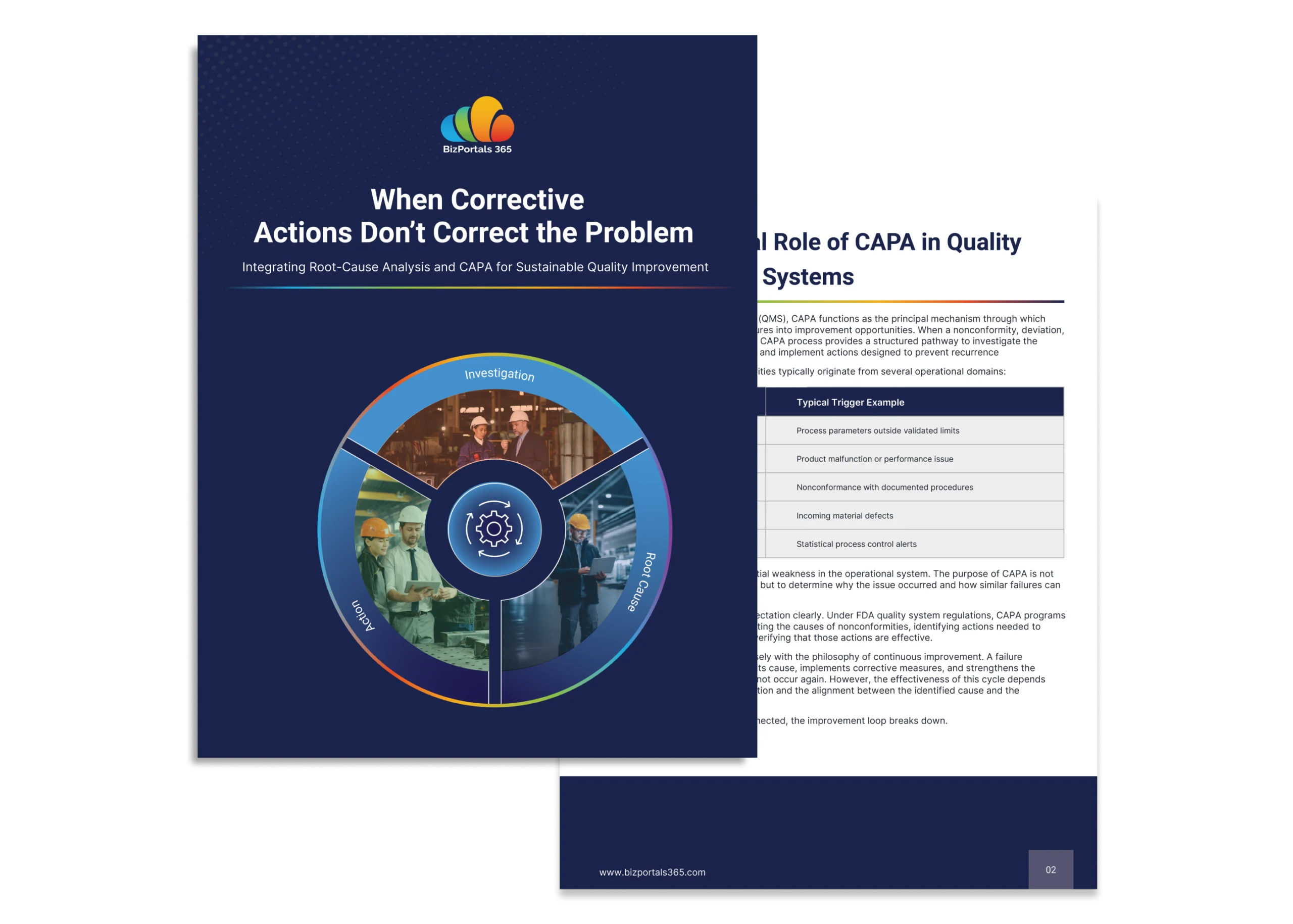
Learn how leading quality teams connect CAPA and root cause analysis to prevent repeat issues and strengthen quality outcomes.
Download the White PaperWhen Should You Issue a Supplier Corrective Action Request (SCAR)?
A SCAR should typically be issued when a supplier-related issue is severe enough to create meaningful business risk, or when a lower-severity issue becomes a recurring pattern.
Not every nonconformance requires a formal SCAR. Treating every supplier issue as a SCAR creates an unnecessary administrative burden and can lessen the impact of formal corrective action requests.
The right trigger criteria usually come down to two dimensions: severity (how much impact does the issue create?) and recurrence (is it an isolated incident or part of a pattern?).
| First-Time Occurrence | Recurring Pattern | |
|---|---|---|
| Low Severity | Informal notice; document internally | Formal SCAR warranted; pattern is itself a signal |
| High Severity / High Risk | Formal SCAR immediately | SCAR plus escalation; begin supplier risk review |
Situations That Warrant a Formal SCAR
- Defective or out-of-spec materials received, especially when they passed your supplier’s own inspection.
- Delivery failures that disrupted your production schedule. Not one-time logistics issues, but process failures on the supplier’s side.
- A supplier
modified its process, material, or subcontractor without notifying you. This is a specification violation regardless of whether the product “still works”. - Findings from a supplier audit that reveal systemic gaps in their quality controls.
- Any issue traceable to a customer complaint or field failure. The risk profile changes the moment your customer is involved.
- Repeat minor issues. The third time a supplier ships under-labeled packaging isn’t minor anymore; the pattern is the problem.

Situations That Probably Don’t Need a SCAR
- A single late shipment with a credible one-time explanation and no production impact.
- A cosmetic defect on non-critical parts below your agreed acceptable quality limit threshold.
- A documentation error that the supplier corrected immediately and correctly on the same shipment.
The key principle: a SCAR should feel significant to the supplier who receives it. Use them where the situation genuinely demands a structured response, not as a form-filling exercise.
Most mature supplier quality programs also build in a graduated response. An informal supplier notification or trend alert before escalating to a formal SCAR. Discussing your SCAR criteria with suppliers during onboarding means no one is surprised when one arrives.
How the Supplier Corrective Action Request (SCAR) Process Works
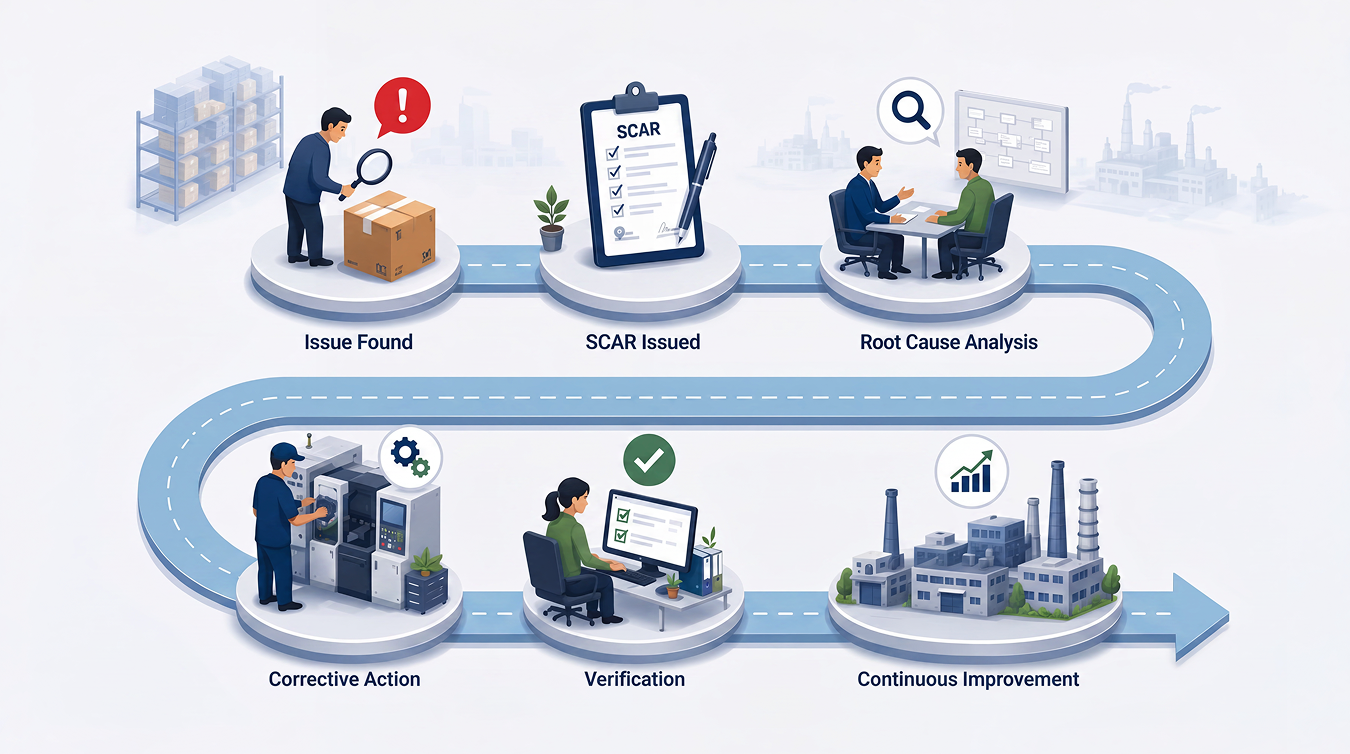
A SCAR doesn’t end when you send the document. It ends when you’ve confirmed the issue has been resolved and is unlikely to happen again. While organizations may have different procedures, most SCAR workflows follow the same eight-stage process.
Stage 1: Identify and Document the Nonconformance
The process begins by documenting the issue clearly and accurately. Capture what was expected, what was received, the affected lot or batch, how the issue was discovered, and any supporting evidence.
This step is more important than many organizations realize. A supplier cannot perform an effective investigation if the nonconformance description is vague. The clearer your documentation, the faster and more accurately the supplier can respond.
Stage 2: Contain the Issue
Before the root cause can be investigated, the immediate risk must be controlled.
Containment may include:
- Quarantining affected materials
- Holding shipments
- Increasing inspections
- Preventing nonconforming products from moving further into production
Containment doesn’t solve the problem. It simply prevents the problem from becoming larger while the investigation is underway.
Stage 3: Issue the Formal SCAR
Once the issue has been documented and contained, the SCAR is formally issued to the supplier.
A typical SCAR includes:
- A unique reference number
- Supplier and product details
- A description of the nonconformance
- Supporting evidence
- Required response information
- Response deadlines
The SCAR should be clear, professional, and focused on the issue. Its goal is to solve the problem, not assign blame.
Stage 4: Supplier Acknowledgment
The supplier confirms receipt of the SCAR, reviews the information provided, and accepts the required response timeline.
If clarification is needed, it should happen early. Misunderstandings at this stage often lead to delays and weak corrective action plans later in the process.
Stage 5: Root Cause Analysis and Response
The supplier investigates the issue to determine why it occurred and what actions are necessary to prevent recurrence.
Common root cause analysis methods include:
- 5 Whys
- Fishbone (Ishikawa) Diagrams
- 8D Problem Solving Methodology
The supplier’s response typically includes:
- Immediate containment actions
- Root cause analysis findings
- Corrective actions
- Preventive actions
- Supporting evidence
One important point: if a supplier identifies “human error” as the root cause, further investigation is usually warranted. Human error is often a symptom of a deeper issue, such as inadequate training, weak procedures, or insufficient process controls.
Need practical templates for root cause analysis, corrective actions, and effectiveness checks?
Get the CAPA Quality Improvement Toolkit and start improving your process right away.
Stage 6: Review the Supplier Response
Your quality team evaluates the supplier’s response to determine whether it adequately addresses the problem.
This is not a box-checking exercise. The goal is to verify that the proposed actions address the actual root cause and are likely to prevent recurrence.
Questions worth asking include:
- Does the identified root cause logically explain the issue?
- Do the corrective actions address that root cause?
- Are the preventive actions meaningful and measurable?
- Is there evidence that containment actions were implemented?
A response that simply adds another inspection step without addressing the underlying cause may reduce symptoms without solving the problem.
Stage 7: Implementation and Monitoring
Once the response is accepted, the supplier implements the agreed corrective and preventive actions.
During this period, organizations often:
- Increase incoming inspections
- Request evidence of completed actions
- Monitor supplier performance more closely
The level and duration of monitoring should reflect the severity of the original issue and the associated business risk.
Stage 8: Verify Effectiveness and Close the SCAR
The final stage is confirming that the corrective actions actually worked.
Effectiveness verification may involve:
- Reviewing future shipments
- Examining inspection data
- Assessing process performance
- Conducting follow-up audits when necessary
This is one of the most commonly overlooked steps in supplier corrective action management. A SCAR should not be closed simply because the supplier submitted a response. It should be closed only after there is evidence that the issue has been resolved and is unlikely to recur.
A useful best practice is to define closure criteria before closing the SCAR, not after. For example, an organization may require multiple consecutive shipments without recurrence before considering the issue resolved.
Once closure criteria are met, formally close the SCAR in your system and update the supplier’s quality record. Organizations operating in regulated environments should also ensure that SCAR records remain readily available for future internal quality audits and supplier evaluations.
What a Strong SCAR Response Looks Like (Versus a Weak One)
The easiest way to evaluate a SCAR response is to ask two questions: Does the response identify a specific root cause, and does it provide evidence that corrective actions were implemented? Strong responses do both. Weak responses rely on vague explanations and unsupported claims.
Here’s the contrast that matters in practice:
Weak supplier response:
- Root cause: “Inspector oversight / human error”
- Corrective action: “We have reminded our team of the specifications”
- Preventive action: “We will increase attention to this part”
- No supporting documentation
Strong supplier response:
- Root cause: “The inspection fixture for this dimension had not been re-calibrated after a maintenance event on [date], resulting in a systematic measurement error across Lot [X]”
- Corrective action: “Fixture has been recalibrated and verified against master gauge. All suspect products from this period has been placed on hold pending re-inspection. Re-inspection results attached.”
- Preventive action: “Calibration interval for this fixture class has been reduced from 90 to 30 days. Calibration schedule has been updated in our maintenance management system. Training record for inspection team updated [date].”
- Attached: calibration certificate, re-inspection records, updated procedure, training records
The difference is specificity and traceability. If a supplier’s response cannot be supported with objective evidence, it should be considered a commitment rather than a verified corrective action.
What If the Supplier Doesn’t Respond?
Not every supplier responds to a SCAR within the required timeframe, and not every response is adequate. For this reason, organizations should define an escalation process before issuing a SCAR.
Common escalation steps include:
- Formal reminders
- Escalation to supplier management
- Enhanced incoming inspection
- Supplier probationary status
- Removal from the Approved Supplier List (ASL), when warranted
The key is consistency. Suppliers should understand the consequences of non-response, and every escalation step should be documented. In many cases, a clearly defined escalation process is enough to encourage timely and meaningful responses.
How SCAR Data Strengthens Your Supplier Quality Program
Each SCAR that moves through your system leaves behind more than a corrective action record. Over time, it reveals patterns that are difficult to see when issues are reviewed one at a time.
The metrics worth tracking by supplier and by time period include:
- SCAR frequency: How many SCARs has this supplier received in the last 12 months?
- Average response time: How quickly do they acknowledge and submit responses?
- RCA quality score: If you evaluate supplier responses against defined criteria, you can score them consistently.
- First-time acceptance rate: What percentage of supplier responses are accepted without being returned for revision?
- Recurrence rate: How often does the same issue reappear after a SCAR has been closed?
- SCAR closure time: How long does it take to move from issue identification to verified closure?
These metrics become much more useful when viewed together rather than in isolation.
For example, a supplier that receives three SCARs in twelve months, all related to dimension control, is telling you something specific about its process capability. That insight can guide a focused supplier audit or improvement discussion far more effectively than a general review.
SCAR data also provides context for supplier scorecards, supplier reviews, and Approved Supplier List decisions. Instead of relying on informal feedback or isolated incidents, quality teams can evaluate supplier performance using documented trends over time.
Managing SCARs Without a QMS: Where It Goes Wrong
A significant number of organizations manage their SCAR process through a combination of email threads, spreadsheets, and PDF forms saved to shared folders. This works, until the volume of suppliers, corrective actions, and audits starts to grow.
The failure modes are usually predictable:
Audit trail fragility: When SCAR records live across multiple email chains and shared drives, reconstructing the complete history of an issue becomes slow and error-prone.
Pattern blindness: A spreadsheet rarely tells you that you’ve issued four SCARs to the same supplier in six months, or that multiple issues share the same root cause category. Someone has to notice those patterns manually.
Supplier visibility gaps: When SCARs are exchanged through email attachments, there is often no single view of status, ownership, or overdue actions.
SCAR-to-CAPA disconnection: When supplier corrective actions and internal corrective actions are managed separately, the relationship between them is easily lost. The supplier may complete its actions while internal process gaps remain unresolved.
None of these problems are usually caused by the SCAR process itself. They emerge when the process becomes difficult to manage consistently.
A connected quality management system brings SCARs, CAPAs, nonconformances, and supplier performance data into the same workflow. As a result, you spend less time chasing records and more time understanding what supplier quality data is actually telling you.
For organizations already managing quality processes across multiple teams and systems, BizPortals QCFlow QMS software supports supplier management processes alongside CAPA and document control, all within the environment your teams already use.
Want to see BizPortals QCFlow in practice? Schedule a live demo, ask questions directly to our experts, and get a personalized walkthrough aligned with your industry workflows.
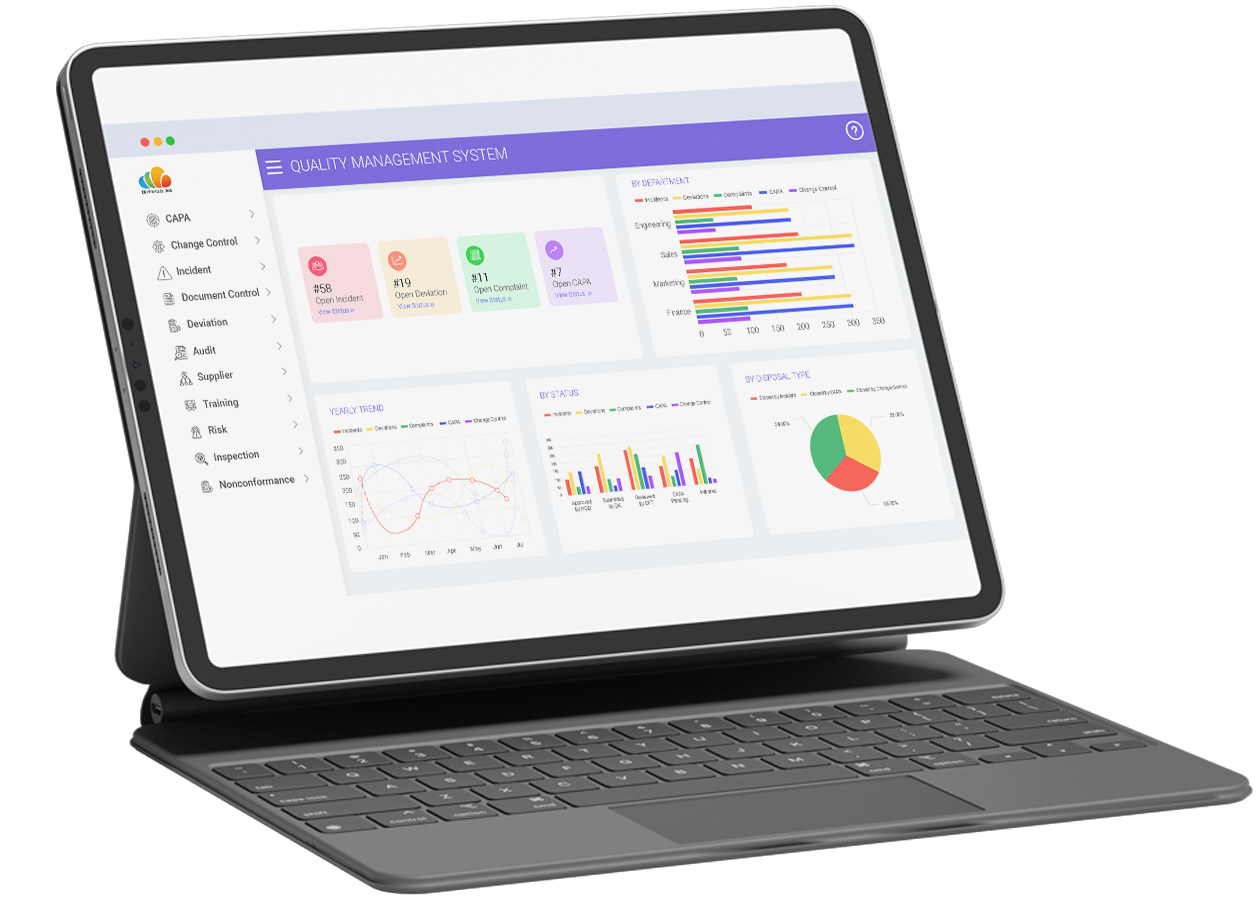
Manage SCARs, CAPAs, audits, and compliance together.
Request a DemoFAQs
-
Should every supplier nonconformance result in a SCAR?
No. SCARs are typically reserved for significant, recurring, or high-risk supplier nonconformances.
-
What are the most common mistakes organizations make when managing SCARs?
Common mistakes include weak documentation, poor root cause analysis, inadequate follow-up, and ineffective closure verification.
-
What information should be included in a Supplier Corrective Action Request?
A SCAR should include the issue, evidence, affected products, response requirements, deadlines, and closure criteria.
-
What happens if a supplier does not respond to a SCAR?
Non-response should trigger escalation, additional monitoring, supplier review, or removal from the Approved Supplier List.
-
How do organizations track supplier corrective action requests efficiently?
Many organizations start with spreadsheets and email, then adopt a QMS as supplier quality processes become harder to manage.
-
How can SCARs, CAPAs, and nonconformances be managed together?
A connected QMS links SCARs, CAPAs, and nonconformances to maintain traceability and streamline corrective action management.