ISO 9001 Compliance Management with BizPortals QCFlow
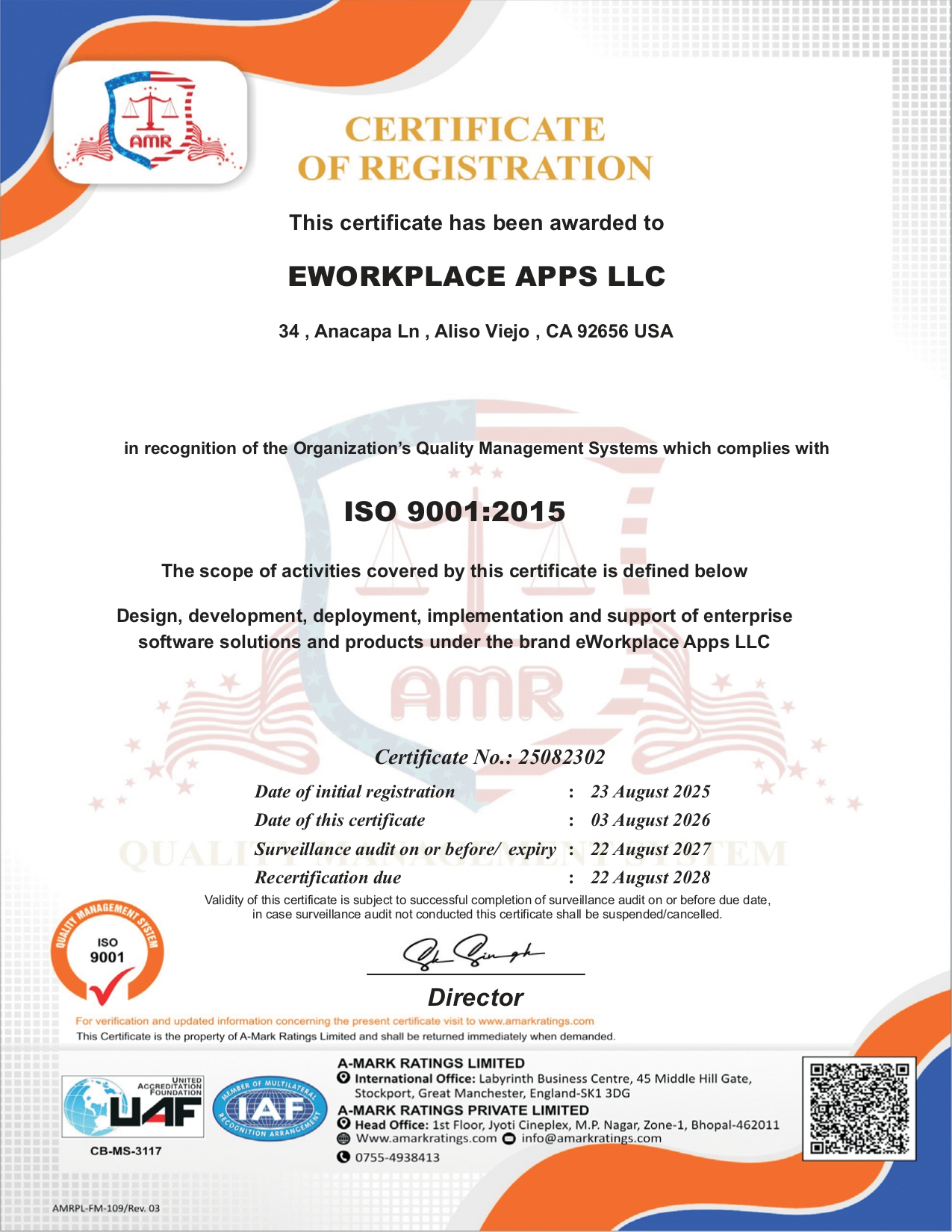
ISO 9001 is an internationally recognized standard for Quality Management Systems (QMS). It helps organizations establish consistent processes, improve operational performance, enhance customer satisfaction, and drive continual improvement across their business operations.
BizPortals QCFlow provides a centralized platform for managing documents, audits, corrective actions, employee training, and process workflows. By digitizing quality operations, organizations can improve process consistency, maintain critical records, and support ongoing compliance initiatives. The following compliance mapping highlights how BizPortals QCFlow supports key ISO 9001 requirements.
| ISO 9001:2015 Requirement | BizPortals QCFlow Feature Mapping |
|---|---|
| 4.1 Understanding the organization and its context - determine internal/external issues relevant to the QMS. | Organization Context / Governance setup can capture internal and external issues, business context, quality challenges and compliance risks. Risk & Opportunity Register can link context issues to QMS risks and actions. |
| 4.2 Needs and expectations of interested parties - identify relevant stakeholders and requirements. | Interested Parties Register can maintain customers, regulatory bodies, suppliers, employees and their quality expectations. Requirement records can be linked with risks, objectives and audits. |
| 4.3 Scope of the QMS - define boundaries and applicability of the quality management system. | QMS Scope Statement / Organization Profile list stores scope, locations, processes, exclusions and applicable standards for audit reference. |
| 4.4 QMS and its processes - establish, implement, maintain and improve required processes. | Process Management module / Process Map list captures process owners, inputs, outputs, KPIs, risks, procedures and linked documents. Dashboards show process status and performance. |
| 5.1 Leadership and commitment - top management must demonstrate accountability for QMS effectiveness. | Management Review module and Executive Dashboard provide leadership visibility into audit results, KPIs, risks, customer feedback, CAPA status and improvement actions. |
| 5.1.2 Customer focus - customer and applicable requirements must be determined and met. | Customer Feedback / Complaint Management captures complaints, escalations, customer perception inputs and related CAPA. KPI dashboard can track customer complaint rate and CSAT. |
| 5.2 Quality policy - establish, communicate and maintain quality policy. | Document Library controls the Quality Policy with approval workflow, version control, effective date, review reminders and employee acknowledgment/training linkage. |
| 5.3 Organizational roles, responsibilities and authorities - assign QMS responsibilities. | Role/Responsibility Matrix and Department/Employee master lists assign process owners, approvers, auditors, CAPA owners and management representatives. |
| 6.1 Actions to address risks and opportunities - plan actions for QMS risks and opportunities. | Risk & Opportunity Register captures risk source, probability, severity, controls, mitigation plan, owner, review frequency and linked CAPA/NC/audit findings. |
| 6.2 Quality objectives and planning to achieve them - define measurable objectives and plans. | Quality Objectives / KPI module captures objective, target, owner, frequency, measurement source, progress, status and management review updates. |
| 6.3 Planning of changes - changes to the QMS must be carried out in a planned manner. | Change Control module captures change request, affected area, justification, risk/impact assessment, approval, implementation actions, training/document updates and effectiveness verification. |
| 7.1 Resources - determine and provide resources needed for QMS operation. | Resource and Infrastructure records can be maintained through asset/equipment lists, department owners, action plans and management review resource actions. |
| 7.1.3 Infrastructure - maintain infrastructure required for operations. | Equipment / Asset Register captures asset ID, location, status, maintenance due date, owner and availability. Maintenance actions can trigger tasks or CAPA where needed. |
| 7.1.5 Monitoring and measuring resources - measuring equipment must be suitable and calibrated. | Calibration / Equipment Management tracks equipment details, calibration due date, status, certificate attachment, reminders and overdue visibility. |
| 7.2 Competence - people performing work must be competent based on education/training/experience. | Training Management maintains training plans, role-based training, attendance, evidence, assessment score, competence level, evaluator approval and retraining workflow. |
| 7.3 Awareness - people must be aware of policy, objectives and contribution to QMS effectiveness. | Document acknowledgment, training assignments, awareness programs and employee training records provide evidence of communication and awareness. |
| 7.4 Communication - determine internal/external QMS communications. | Communication Matrix can define what is communicated, audience, owner, method, frequency and evidence. Notifications and workflow comments support operational communication. |
| 7.5 Documented information - documents and records must be controlled, available and protected. | Document Library provides version control, approval workflow, access control, effective dates, revision history, acknowledgments, archive and searchable audit evidence. |
| 8.1 Operational planning and control - plan, implement and control processes needed to meet requirements. | Process Management, SOPs, tasks, checklists and operational records define controls, owners, criteria, status and linked evidence for controlled execution. |
| 8.2 Requirements for products and services - determine, review and communicate customer requirements. | Customer Requirement / Contract Review list can capture requirement details, review status, feasibility, owner, changes and customer communication evidence. |
| 8.4 Control of externally provided processes, products and services - control suppliers and outsourced processes. | Supplier Management maintains approved vendor list, supplier evaluation, rating, audit date, approval status, certificate expiry, supplier NCs and supplier CAPAs. |
| 8.5 Production and service provision - controlled conditions must be maintained. | Operational records, SOPs, work instructions, inspection records, equipment status, training evidence and process KPIs support controlled production/service execution. |
| 8.6 Release of products and services - release only after planned arrangements are completed. | Inspection / Release Approval list can maintain acceptance criteria, inspection results, evidence, reviewer, approval date and release decision. |
| 8.7 Control of nonconforming outputs - prevent unintended use or delivery of nonconforming outputs. | NC module captures nonconformance details, product/process impact, containment, disposition, owner, approval, action and closure. CAPA can be triggered where needed. |
| 9.1 Monitoring, measurement, analysis and evaluation - monitor QMS performance and customer satisfaction. | KPI Dashboard and Quality Metrics library track customer complaints, CSAT, CAPA closure, audit findings, process performance and other QMS indicators. |
| 9.2 Internal audit - conduct internal audits at planned intervals. | Audit Management supports audit planning, audit criteria, checklist execution, findings, severity, evidence attachment, CAPA linkage, follow-up and closure. |
| 9.3 Management review - top management must review QMS suitability, adequacy and effectiveness. | Management Review module captures audit results, KPI performance, risks/opportunities, customer feedback, resource needs, improvement actions and decisions. |
| 10.1 Improvement - determine opportunities for improvement and implement actions. | Continual Improvement / CI Tracker and CAPA dashboard capture improvement ideas, owners, actions, due dates, benefits and verification. |
| 10.2 Nonconformity and corrective action - react to NC, evaluate need for action, implement and verify effectiveness. | NC + CAPA workflow captures NC logging, containment, RCA, corrective action planning, implementation, evidence, verification, effectiveness check and closure. |
| 10.3 Continual improvement - continually improve suitability, adequacy and effectiveness of the QMS. | Dashboards, management review actions, trend analysis, CAPA effectiveness, audit insights and continual improvement tracker support ongoing QMS improvement. |
Maintaining ISO 9001 compliance requires well-defined processes, controlled documentation, continuous monitoring, and a commitment to ongoing improvement. A centralized quality management system can help organizations strengthen process consistency, accountability, and compliance readiness across the enterprise.
To see how BizPortals QCFlow supports these objectives in a real-world environment, request a personalized product walkthrough. Our experts will demonstrate how the platform helps manage quality processes, automate compliance activities, and support your organization’s ISO 9001 compliance journey.