Summary:
This guide explains what a CAPA report is, why it is important, when it should be created, and how it differs from a CAPA action plan. You will learn the key elements of an effective CAPA report format, review a practical example, and discover best practices for maintaining compliance and improving quality outcomes.
Quality issues can have significant operational, compliance, and business consequences if they are not handled properly. But resolving the issue is only part of the process. Organizations must also demonstrate how the issue was identified, investigated, corrected, and prevented from recurring.
But how do organizations document and validate all of these activities?
A Corrective and Preventive Action (CAPA) report is a structured quality management document that captures the complete journey of a quality issue. It provides the documented evidence needed to show that an issue was not only addressed but also investigated and controlled systematically.
For regulated industries, CAPA reports play a crucial role in maintaining compliance, supporting audits, strengthening accountability, and driving continuous improvement.
In this guide, we will explore the purpose of a CAPA report, when it should be created, the key elements of an effective CAPA report format, practical examples, and best practices that help organizations build a more consistent and audit-ready quality management process.
What is a CAPA Report?
A Corrective and Preventive Action (CAPA) report is the primary document used to manage and track a CAPA from initiation to closure. It captures the information, decisions, actions, and approvals associated with a quality issue throughout its lifecycle.
A typical CAPA report includes details such as the problem description, investigation findings, root cause analysis, corrective actions, preventive actions, responsibilities, implementation timelines, effectiveness verification, and closure records. It also includes the CAPA action plan, which outlines the specific actions required to address the issue and prevent its recurrence.
A well-maintained CAPA report also serves as a reference point for future investigations, helping teams identify recurring patterns, evaluate past decisions, and strengthen overall quality performance over time.
However, if a CAPA report already includes a CAPA action plan, why do organizations maintain both? Understanding the difference is essential for effective CAPA management.
Difference Between CAPA Reports and CAPA Action Plan
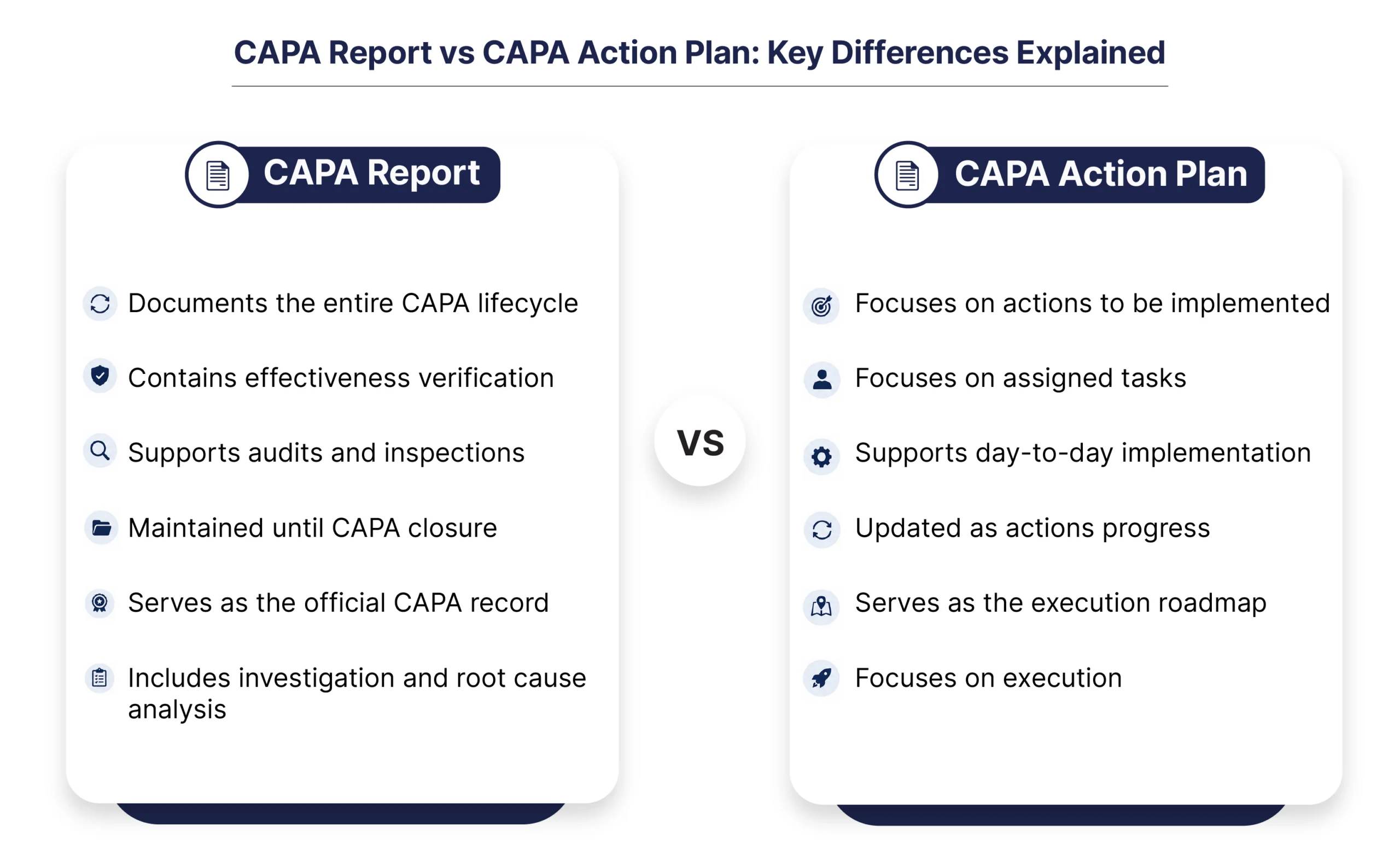
Although a CAPA report includes a CAPA action plan, the two serve different purposes within the CAPA process.
- A CAPA report documents the entire CAPA process, from issue detection and investigation to implementation, effectiveness verification, and closure. A CAPA action plan, on the other hand, focuses specifically on the actions required to address the issue and prevent its recurrence.
- A CAPA report is a detailed, comprehensive document that includes root cause analysis, risk assessment, and follow-up actions. In contrast, a CAPA action plan is action-focused and less inclined towards investigation and effectiveness of the actions.
- While a CAPA report is required for regulatory audits and inspections, a CAPA action plan serves the purpose of an internal document required for process execution.
Why CAPA Reports Matter
CAPA reports transform quality issues into actionable knowledge by documenting what happened, why it happened, and how similar issues can be prevented in the future.
According to FDA, CAPA serves as a gauge of the overall health of a quality management system and is reviewed during routine quality system inspection. Regulatory observations frequently cite inadequate investigations, incomplete root cause analysis, ineffective corrective actions, and insufficient documentation, making it even more important for organizations to maintain a comprehensive CAPA report.
When Should a CAPA Report Be Created?
A CAPA report must be created in case of a quality event, operational issue, or compliance failure which requires formal investigation and documented CAPA procedures. Here, the objective is not only to resolve the issue but also to identify its root cause, prevent recurrence, and maintain evidence for internal and external audits and compliance reviews.
Typically, a CAPA report can be created in case of:
- Customer complaints
- Product defects or quality issues
- Nonconformances and process deviations
- Internal audit findings
- Inspection observations
- Supplier quality issues
- Regulatory non-compliance
- Equipment or system failures
- Safety incidents
- Recurring quality incidents or similar trends
Some quality events may also originate outside the organization. For example, supplier-related defects, material quality issues, or recurring vendor nonconformances often require formal investigation and corrective action. In such situations, organizations may issue a Supplier Corrective Action Request (SCAR) to document the issue, communicate expectations, and verify that appropriate corrective actions have been implemented.
For better understanding, let us explore a standard CAPA report format.
The Perfect CAPA Report Format
Although CAPA report formats may vary across industries, most follow a similar structure. The specific fields, documentation requirements, and level of detail often depend on an organization’s regulatory and operational requirements.
For example, pharmaceutical companies often require detailed investigation records, validation data, and regulatory documentation, whereas food and beverage organizations may place greater emphasis on traceability, supplier controls, and food safety requirements.
Despite these variations, most CAPA reports are organized into two primary sections: the Preliminary CAPA Report, which documents the investigation and planned actions, and the CAPA Closure Report, which verifies implementation, effectiveness, and final closure.
Preliminary CAPA Report:
CAPA Description: The description involves a high-level summary of the quality issue. It highlights the systems, products, or processes that are impacted, and other necessary details, such as the department or teams involved, etc., required to further investigate the issue.
Problem/Issue Description: This section presents the nature and extent of the issue, providing the actual timeline of the quality event to assess its severity and aid in proper incident classification and decision-making.
Root Cause Analysis: The primary aim of this section is to present the underlying cause of the issue. It also highlights the process and outcome of the investigation conducted to highlight the root cause.
Corrective Actions: It lists all the immediate measures that need to be taken while mitigating the issue or its effects, including short-term and long-term corrective actions, and clearly defines the responsibilities of the employees, teams, and departments involved.
Preventive Actions: This section outlines all the preventive actions required to address the systemic weaknesses that led to the occurrence of the quality event, with a focus on improving quality checks, updating SOPs, employee training, and more.
CAPA Closure Report:
Implementation and Monitoring: In this section, the CAPA report describes how corrective and preventive measures were executed in accordance with internal quality policies and regulatory standards while also explaining how these actions were monitored through regular audits, inspections, and quality checks, supported by documented evidence.
Effectiveness Verification: This section includes data collected from reports, inspections, and feedback to highlight the effectiveness of the CAPA, ensuring that the issue has been resolved successfully.
CAPA Closure: This section of the CAPA report officially closes the CAPA process. It presents a summary of actions taken during the process, verifications, decisions, and approvals, along with their supportive documentation.
Real-World CAPA Report Example: Turning Theory into Action
Let’s understand how a CAPA report works in practice through a real-world example.
Imagine a pharmaceutical manufacturer discovers during routine quality testing that one of its tablet batches fails the potency test. The active ingredient concentration is lower than the required specification, potentially affecting the product’s effectiveness and quality.
In this situation, the organization would initiate a CAPA process to investigate the issue, identify its root cause, implement corrective and preventive actions, and verify their effectiveness.
The following example shows what a CAPA report for such an incident might look like.
Basics
- Preliminary CAPA Report
- Report Title: Potency Failure in Drug Batches
CAPA Report Number: CAPA-2026-010 - Date of Report: January 15, 2026
Department / Team: Quality Assurance (QA) - Product / Process Affected: Drug Batch SEM (Active Ingredient: Drug Compound A)
- Reported By: Asa Smith, QA Lead
Problem/Issue Description
- Problem Statement: Several batches of drug SEM failed the potency test, showing lower than required level of compound A
- Impact Assessment: This issue could lower the drug’s effectiveness and affect safety and quality
- Reference to Previous Issues: No prior issues with potency failure have been reported for this product
Root Cause Analysis
- Analysis Method Used: Root cause analysis was conducted using 5 Whys methodology
- Root Cause Description:
- Inconsistent mixing times in the formulation process, which resulted in uneven distribution of the active pharmaceutical ingredient (API) in the end product
- Human error during the mixing process and insufficient training on new equipment contributed to the issue
Corrective Actions
- Description of Corrective Actions:
- Immediate retraining of personnel involved in the mixing process
- Equipment calibration and a review of mixing procedures to ensure proper uniformity
- Reprocessing of affected batches by adjusting the formulation procedure to ensure consistent potency
- Responsible Person/Team:
- John Smith, QA Manager (for training and documentation)
- Manufacturing Team (for reprocessing and calibration)
- Timeline for Completion:
- Personnel retraining: February 5, 2026
- Equipment calibration: February 3, 2026
- Reprocessing of batches: February 15, 2026
- Verification Method:
- Potency testing of reprocessed batches
- Review training and calibration records
Preventive Actions:
- Description of Preventive Actions:
- Revise SOPs for mixing and API distribution controls
- Implement a double-check system for potency tests
- Provide additional training on new equipment and processes
- Responsible Person/Team:
- Sarah Thompson, Training Coordinator
- Operations Manager, Manufacturing
- Timeline:
- SOP revision: February 10, 2026
- Double-check system: February 20, 2026
- Training program: Ongoing since February 1, 2026
- Verification:
- Review updated SOPs
- Monitor the double-check system in production runs
- Evaluate training attendance and effectiveness
CAPA Closure Report:
Implementation and Monitoring
- Implementation Status: Corrective actions have begun, with training scheduled and equipment calibration in progress
- Monitoring Plans:
- Weekly audits of the mixing process for the next three months
- Potency testing on every batch produced for the next quarter
- Continuous review of training progress
Effectiveness Verification
- Verification Results: Preliminary potency tests from reprocessed batches indicate successful correction with consistent potency within the acceptable range
- Follow-up Actions:
- Complete verification of all reprocessed batches by March 20, 2026
- Continuous monitoring of potency for the next 3 months to ensure no recurrence
- Outcome: Potency of the reprocessed batches has been successfully normalized, and corrective actions are working effectively
CAPA Closure
- Closure Date: April 5, 2026
- Final Approval: Jane Doe, Head of Quality Assurance
- Documentation:
- All training and calibration records
- Potency test results for reprocessed batches
- Updated SOPs
CAPA Reports Best Practices
An effective CAPA report often depends not on what actions are taken, but how clearly they are documented. And an accurate and evidence-based account of the entire quality event plays an important role in presenting a well-written CAPA report.
Record Findings Immediately: Capture details as soon as an issue is identified to ensure information remains accurate and complete.
Support Conclusions with Objective Evidence: Use audit findings, test results, inspection records, production data, and other supporting documentation to validate decisions and actions.
Focus on root cause and not symptoms: Perform a rigorous root cause analysis to examine the underlying cause to reduce the chance of recurrence. Avoid prioritizing CAPA closure rates over the quality and effectiveness of corrective actions.
Define clear responsibilities and timelines: Assign ownership for each action and establish realistic completion dates to improve accountability.
Verify effectiveness before closure: Confirm that corrective and preventive actions have successfully resolved the issue and prevented recurrence before formally closing the CAPA.
Maintain documented information of the entire procedure: Make sure all investigations, approvals, actions, verifications, and supporting documents are retained for future reference, specifically for external audits and inspections.
In this way, you can create CAPA reports that are easier to review, audit, and use as a foundation for ongoing quality improvement initiatives.
How a Quality Management System Improves CAPA Reporting
As organizations scale, managing CAPA reports manually often becomes increasingly challenging. Information gets scattered across emails, spreadsheets, shared folders, training records, audit reports, and departmental network drives. This fragmentation makes it difficult to maintain visibility into assigned responsibilities, supporting documentation, and CAPA progress.
Dedicated CAPA management software helps bring these activities together within a structured workflow. Standardized CAPA report templates with configurable metadata fields make it easier to capture investigation details, attach supporting evidence, document recommendations, manage approvals, and maintain electronic signatures, helping ensure consistency, accuracy, and accountability throughout the process.
Furthermore, capabilities such as detailed activity logs, task management, centralized document repositories, and cross-functional quality process integration help quality teams reduce administrative effort, improve accountability, simplify audit preparation, and maintain greater confidence in the accuracy and effectiveness of their CAPA reports.
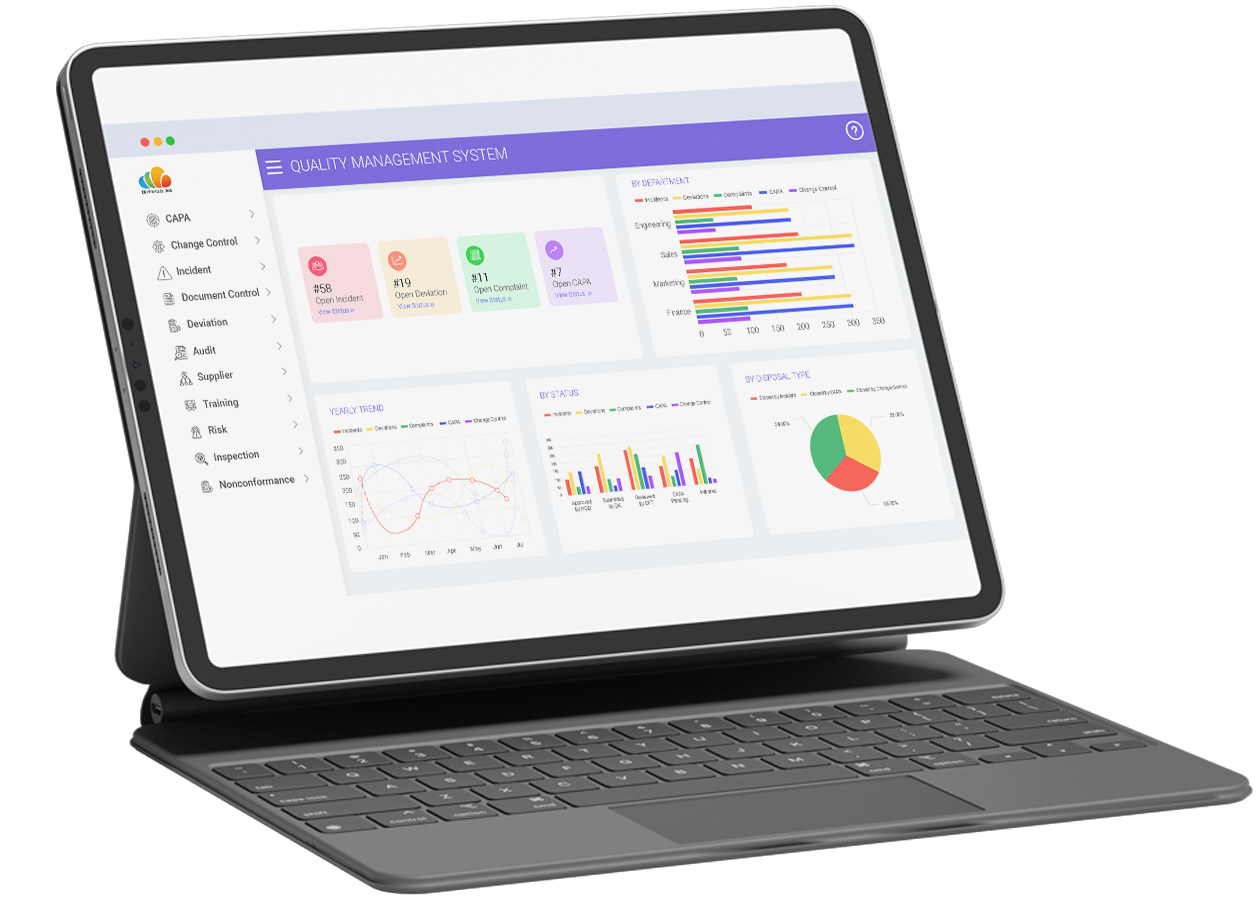
BizPortals QCFlow, a scalable quality management software (eQMS), helps quality teams streamline CAPA reporting by centralizing documentation, improving traceability, and maintaining accurate, compliant, and audit-ready records.
If you would like to see how BizPortals QCFlow supports your quality objectives, schedule a personalized demo with our team.
Streamline investigations, actions, and compliance in one place.
See BizPortals QCFlow in ActionFAQs
-
What is included in a CAPA report?
Typically, an effective CAPA report includes problem description, root cause analysis, corrective actions, preventive actions, responsibilities, timelines, effectiveness verification, supporting evidence, and approvals.
-
Who is responsible for preparing a CAPA report?
CAPA reports are usually created by quality teams and are rarely created by one person alone. Effective CAPA reporting requires inputs from multiple departments, including quality assurance, manufacturing, engineering, audits, and compliance, depending on the nature of the quality event.
-
What is the difference between a CAPA report and a CAPA action plan?
A CAPA action plan focuses on what steps need to be taken to effectively resolve any quality issue. A CAPA report documents these steps taken to systematically address the quality issue. The CAPA action plan is a part of the CAPA report but not a replacement for it.
-
What industries require CAPA reports?
CAPA reports are commonly used in industries where quality, compliance, safety, and traceability are critical. This includes pharmaceuticals, medical devices, manufacturing, food and beverage, life sciences, aerospace, automotive, and other regulated sectors.
-
When should a CAPA report be created?
A CAPA report should be created whenever an issue requires formal investigation and documented corrective and preventive actions. The common triggers typically include customer complaints, product defects, process deviations, audit or inspection findings, and regulatory observations.
-
Why is root cause important in a CAPA report?
The effectiveness of a CAPA report truly depends on the quality of its root cause analysis. Without identifying the actual root cause, quality teams might end up treating symptoms rather than solving the underlying problem, increasing the risk of recurrence.
-
What is a CAPA closure report?
A CAPA closure report is the final confirmation that all planned actions have been completed, reviewed, and verified. It provides documented evidence that the issue has been resolved and that the corrective and preventive actions were effective.
-
What evidence should be included in a CAPA report?
Depending on the issue, the evidence might include audit findings, inspection reports, test results, process data, complaint copies, verification records, photographs, etc.
-
How do CAPA reports support audits and inspections?
CAPA reports provide auditors and inspectors with evidence that quality issues were identified, investigated, addressed, and verified through a controlled process. It demonstrates accountability, traceability, and the organization’s commitment to continuous improvement.